Why Users Trust AI Drafts More Than AI Decisions
Improve AI product adoption by learning why users trust AI drafts more than decisions and how to design better control, evidence and recovery.

Your users will ask AI for a first draft, edit it for two minutes, then ship it under their own name. The same users may reject an AI feature that picks the next customer to contact, approves a support reply or decides which insight belongs in a board deck.
That is not a contradiction. It is the adoption break.
AI product adoption often looks healthy when the feature drafts, summarizes or suggests. Then usage drops when the product asks the same user to accept an AI decision. The model may be just as accurate. The UX may be cleaner. The problem is that the product changed the user’s role without changing the trust surface.
Why users trust AI drafts more than AI decisions
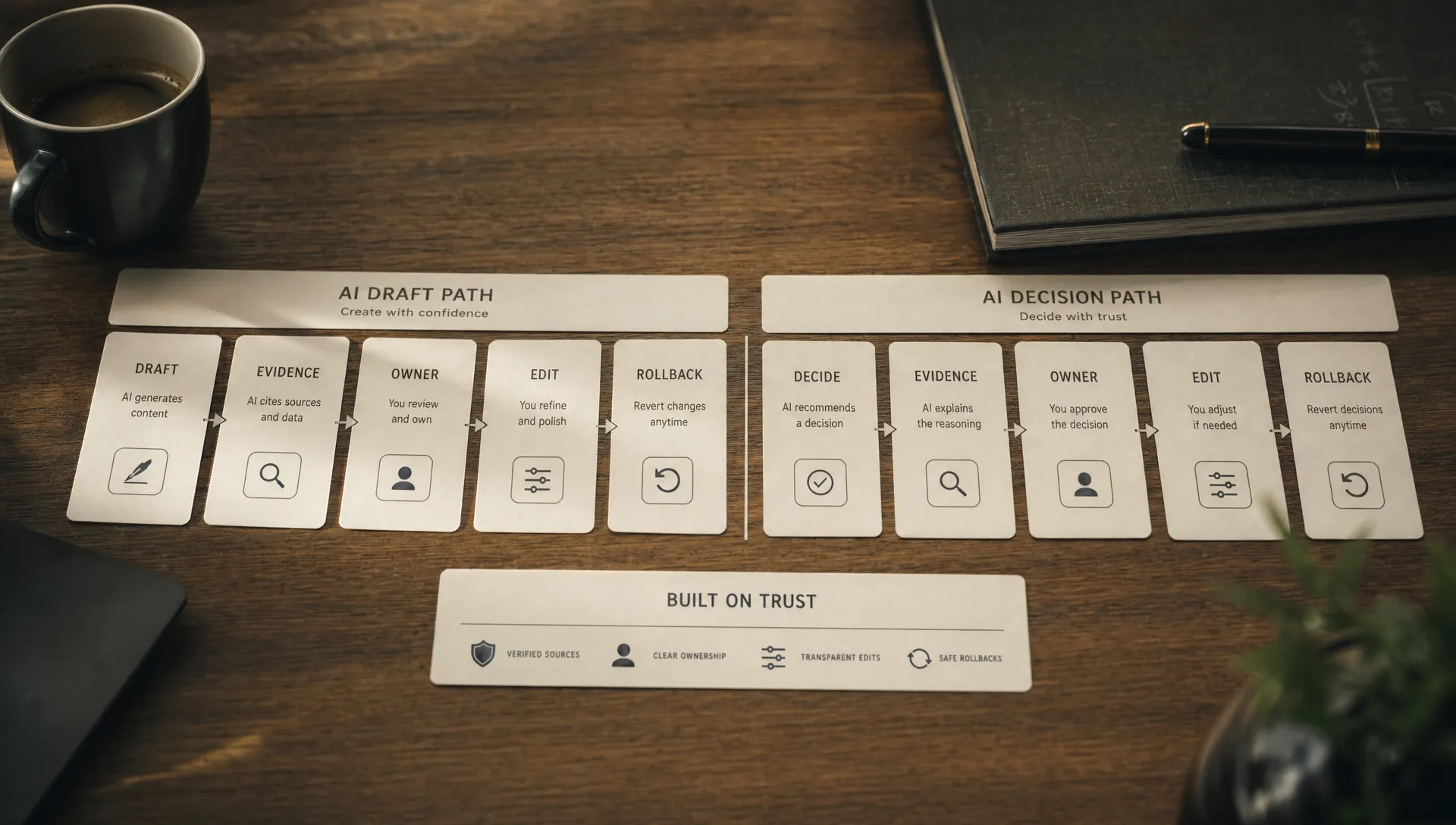
A draft keeps the user in the author seat. It gives them raw material, not a final outcome. They can scan it, delete a paragraph, change the tone, add missing context and still feel like the work is theirs.
A decision is different. It crosses a line from “help me think” to “act for me.” That line matters because the user is still accountable after the AI acts. Their manager, customer or client will not blame the model. They will blame the person who accepted the output.
This is why trust is not just a belief about model quality. It is a judgment about responsibility. If your product hides that shift, users feel it anyway. They slow down, double-check everything or retreat to draft mode.
This connects to a broader trust pattern: users trust AI differently when they own the decision. Drafting preserves ownership. Automated decisions often blur it.
The adoption break is not accuracy, it is accountability
Teams often respond to low decision adoption by asking for a better model. Sometimes that is right. More often, it is incomplete.
If users already trust the AI to draft the thing, the model has probably cleared a basic quality bar. The deeper issue is that the product is now asking the user to accept downstream risk.
A sales rep may accept an AI-written email draft because they can tune it before sending. They may resist an AI-ranked account list if the ranking changes their pipeline focus. A product manager may accept an AI summary of research notes. They may resist an AI recommendation to kill a feature because that decision has political, strategic and career consequences.
Draft trust is cheap because review is built into the task. Decision trust is expensive because review must happen before damage. If the user cannot inspect the basis of the decision, they either over-review or do not use it.
That is where many AI adoption problems start. The product moves from assistance to delegation, but the interface still behaves like a suggestion box.
A diagnostic table for the trust gap
Before redesigning the feature, separate the symptom from the root cause. “Users do not trust the AI” is too broad to act on. You need to know whether they distrust the output, the decision boundary or the recovery path.
| Symptom in the product | Likely diagnosis | Better product response |
|---|---|---|
| Users copy drafts but ignore recommendations | They trust generation, not prioritization | Show criteria, tradeoffs and why this item ranked higher |
| Users regenerate many times before accepting | They lack control over direction | Add constraints, examples and partial accept controls |
| Users accept only low impact suggestions | Risk is not bounded | Let users choose automation scope by risk level |
| Users review every AI decision manually | Verification cost is too high | Make evidence visible near the decision |
| Users disable automation after one bad outcome | Recovery feels unclear | Add rollback, audit history and safe defaults |
The table is useful because it stops the team from treating all trust issues as the same issue. A user who keeps editing AI drafts is not behaving like a user who refuses AI decisions. Those are different adoption states.
Three product patterns that make AI decisions feel unsafe
Most decision trust failures come from a small set of product choices. They are easy to miss because the AI feature may look polished in a demo.
The user cannot see the basis of the call
A decision without visible evidence feels like a guess, even when the model is strong. The user needs to know what the AI considered, what it ignored and where the uncertainty sits.
This is not solved by adding a confidence score. “87 percent confident” does not tell a support lead whether the answer used the latest policy. It does not tell a recruiter whether the ranking over-weighted a weak signal. If users cannot check the output, they will not build durable trust. This is why AI trust drops fast when users cannot check the output.
The system skips the “almost right” stage
Drafts are allowed to be imperfect. Decisions are not.
That creates a useful design principle: do not jump from draft assistance to full automation too quickly. Many products need an intermediate mode where the AI proposes a decision and the user edits the criteria, not just the result.
For example, instead of “AI selected these five accounts,” try “AI selected these five accounts because they match renewal risk, recent activity and expansion fit.” Then let the user remove or add criteria. That turns the AI from a black box into a collaborator the user can steer.
Recovery is vague
Users are more willing to accept automation when they know what happens after a mistake. Can they reverse the action? Can they see what changed? Can they explain the decision to someone else?
If the answer is unclear, they treat every AI decision as final. That makes even small decisions feel risky. A simple undo flow, decision log or approval step can increase adoption more than another round of prompt tuning.
When automation is fine, and why that matters
Not every AI decision needs heavy review. Some decisions are low risk, easy to reverse or bounded by clear user preferences. In those cases, users may welcome automation.
Look at ambient systems such as AI-controlled lamps. The system can adapt lighting based on context because the decision space is narrow, the outcome is visible and the user can override it. That does not make lighting trivial. It means the product has a clear boundary.
The same logic applies to SaaS. An AI that auto-tags internal notes may be fine if tags are easy to correct. An AI that changes pricing, sends customer messages or marks work complete needs a much stronger trust surface.
The practical question is not “Should this be automated?” It is “What level of automation matches the cost of being wrong?”
What to measure before changing the model
If users trust drafts but not decisions, your AI adoption metrics need to split those behaviors. A single activation rate will hide the problem.
Track these separately:
- Draft generation rate: how often users ask the AI to produce raw material
- Draft reuse rate: how much of the output survives into the final work
- Recommendation view rate: how often users inspect AI decisions
- Decision acceptance rate: how often users accept the AI call without replacing it
- Override reason: why users reject, edit or ignore the decision
- Recovery use: how often users undo or correct AI actions
The most useful metric is often not acceptance. It is abandonment after inspection. If users open the recommendation, look at it and then leave, the issue is probably not discovery. It is trust at the decision point.
You can also segment by risk. Users may accept AI decisions in private workflows but reject them in customer-facing workflows. That tells you where to add evidence, approvals or rollback.
How to redesign the handoff from draft to decision
A stronger decision flow does not need to be heavy. It needs to match the user’s risk model.
Start by making the handoff explicit. Label the mode change. “Draft a response” and “Send recommended response” are different jobs. If your interface treats them the same, users will supply the caution themselves.
Then expose the decision basis. Show the inputs, rules, examples or sources that shaped the AI call. Keep this close to the action, not hidden in a log. Users should not need to investigate the product to verify the product.
Next, let users control the boundary. They may be comfortable letting AI decide for low value tickets, internal drafts or reversible settings. They may want approval for high value accounts, regulated content or customer-visible actions. A good AI product lets users set that line.
Finally, make recovery obvious. Undo is not a minor UX detail in AI decision systems. It is part of the trust contract.
FAQ
Why do users trust AI drafts but reject AI recommendations? Drafts keep the user in control. Recommendations often imply a decision the user must defend later. If the product does not show evidence, scope and recovery, users hesitate.
Is this just a model accuracy problem? Sometimes, but not always. If users reuse drafts but ignore decisions, the model may be good enough for generation. The adoption problem is more likely verification cost, accountability or unclear recovery.
Should AI products avoid automated decisions? No. Automated decisions work when risk is bounded, evidence is visible and users can override or recover. The mistake is moving to automation before the trust surface is ready.
What is the best first fix for low AI decision adoption? Add a reviewable decision basis near the action. Show why the AI made the call, what inputs it used and what the user can change before accepting it.
Turn the symptom into a product decision
If your AI feature is used for drafts but ignored for decisions, do not start with a bigger roadmap. Start with the handoff. Find the moment where the user stops feeling like the owner and starts feeling like the approver of a black box.
For teams that want a structured way to run that diagnosis, the AI Product Adoption Deck includes diagnostics, action cards and workshop templates for mapping symptoms like trust gaps, output abandonment and weak retention to concrete product changes.