Why AI Workshops Produce Ideas but No Product Changes
AI workshops generate ideas but no product changes? Diagnose missing evidence, decision ownership and follow-through, then turn discussion into action.

Your team leaves AI workshops with a board full of ideas. Two weeks later, the same users are still abandoning drafts, regenerating answers or ignoring the feature after their first try. Nothing in the product has changed.
The session may have been engaging. That does not make it productive. The failure is usually in the handoff from discussion to a product decision. Nobody has committed to a specific user problem, a bounded change or evidence that would justify shipping it.
Before booking another session, diagnose where that handoff broke.
Find the missing decision
Open the notes from your last workshop. Can someone who missed the session tell what the team decided to change, why and who owns the next step?
If not, the output is a record of participation, not a delivery artifact.
| What the workshop produced | What is still missing | What to resolve |
|---|---|---|
| “Users need more trust” | The specific reason users hesitate | Whether they cannot verify, correct or safely apply the output |
| A list of feature ideas | A choice between competing responses | Which change addresses the observed break |
| A polished prototype | Evidence that it solves the problem | What users must do differently during testing |
| Agreement to investigate | An accountable next step | Who will collect which evidence and when |
These are different failures. Better facilitation will not fix all of them. If the underlying symptom is still unclear, use the free adoption triage tool before discussing solutions.
Why AI workshops stop at ideas
Three gaps explain why a useful conversation can leave the backlog untouched: weak evidence, missing decision authority and outputs that cannot enter delivery.
A convincing demo substitutes for user evidence
A generated answer can look impressive in a room while being unusable in someone’s actual work. Participants judge what they can see: fluency, speed and presentation. They may never experience the verification or correction work that follows.
Consider a hypothetical support-drafting feature. Agents generate replies but close the panel without inserting them. The workshop proposes friendlier wording.
That response assumes tone is the problem. Agents might instead be checking every policy claim against another system. Or they might need to preserve part of their existing reply rather than replace it.
The useful input is a trace of that behavior: the draft, the agent’s next action and their explanation. Without it, the session produces competing stories about the problem.
The room can recommend but cannot choose
AI workshops stall when everyone can suggest changes but nobody can accept the tradeoffs.
Adding supporting evidence might help users verify an answer. It also creates decisions about source visibility, missing evidence and what happens when sources disagree. Those decisions can cross product, design, engineering and risk responsibilities.
Consensus that “citations would help” does not resolve them.
Check whether the session included someone authorized to choose a scope and commit capacity. If not, the appropriate output is a decision request for that person, with options and consequences. Calling it an approved experiment only hides the dependency.
The deliverable cannot enter the team’s workflow
A board labeled “trust,” “personalization” and “better onboarding” is not ready for implementation. Someone still has to translate those themes into behavior, interaction rules and acceptance criteria.
That translation is substantial product work. When it has no owner, the workshop appears complete while the difficult part remains untouched.
Training can reasonably end with a new skill. A product-change session needs a different finish line: a decision, a testable specification or a clearly assigned research task. A prototype alone is insufficient if nobody knows which behavior it is meant to change.
Replace the idea summary with a decision record
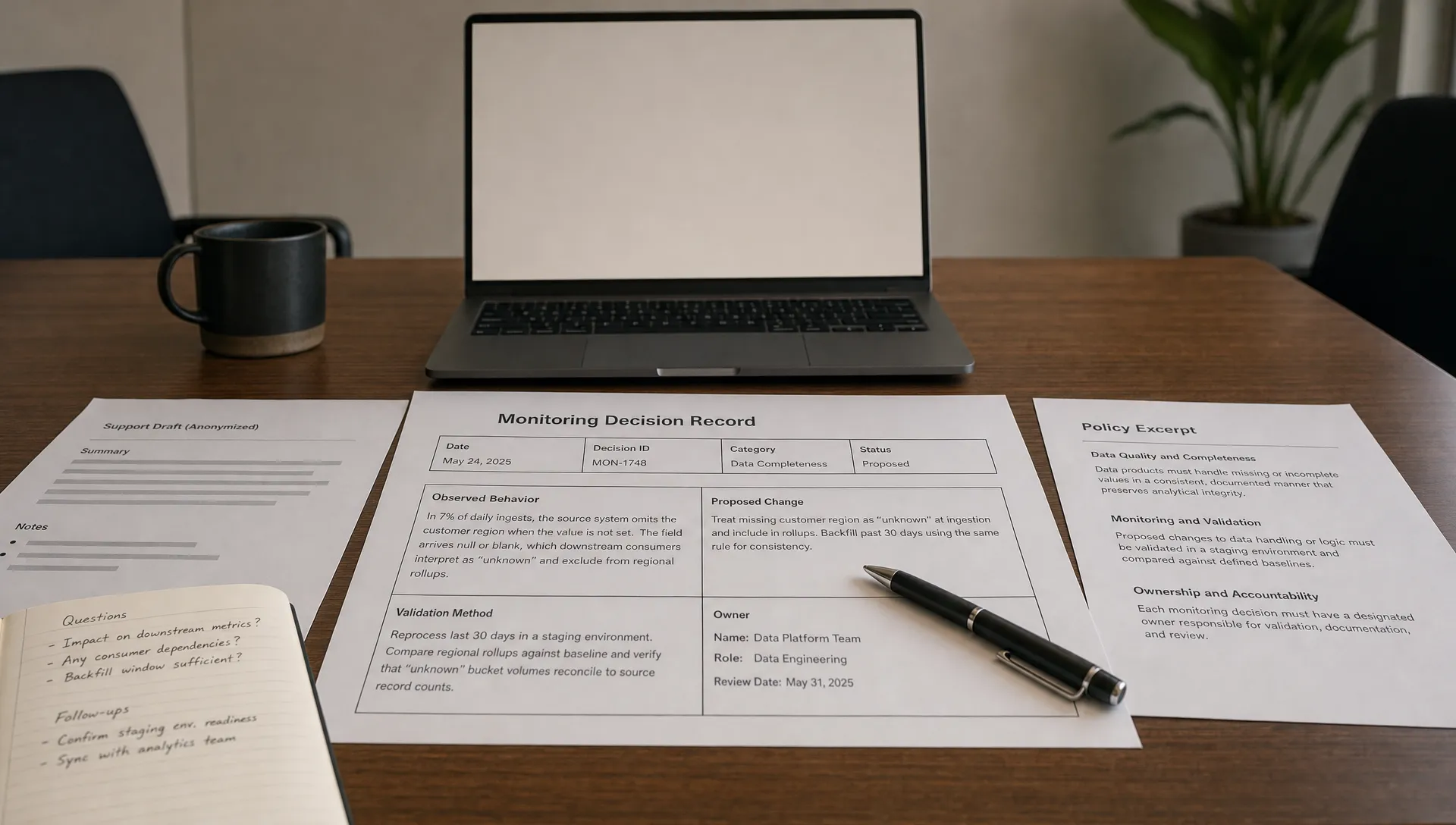
The most useful output from AI workshops is a record that survives outside the room. It should explain enough for another teammate to challenge, design or implement the proposed response.
For the hypothetical support-drafting feature, that record might look like this:
| Field | Example decision record |
|---|---|
| Observed symptom | Agents generate a draft but leave without inserting it |
| Evidence | Reviewed sessions show agents checking policy claims elsewhere |
| Working hypothesis | Verification effort makes the draft slower to use than writing manually |
| Proposed change | Show the supporting policy passage beside each relevant claim |
| Boundary | Do not imply that a linked passage guarantees the whole reply is correct |
| Validation | Observe whether agents can verify and apply a reply without overlooking unsupported claims |
| Ownership | Name the delivery owner and the person responsible for reviewing the test |
This is an illustrative hypothesis, not a prescribed fix. If the evidence instead shows agents struggling to preserve their own wording, revision controls deserve investigation first.
The record should also state what was rejected and why. Otherwise, the same attractive ideas return at the next planning meeting, detached from the evidence that ruled them out.
Measure changed behavior, not workshop satisfaction
A positive participant survey tells you whether the session felt useful. It does not tell you whether users can complete their work more effectively.
For product-focused AI workshops, evaluation needs two layers. First, did the session produce a decision that entered delivery or research? Second, did that work address the adoption break?
Choose the user measure from the diagnosis. If users abandon drafts, track whether appropriate drafts get applied, not simply whether generation increases. If users repeatedly regenerate, examine whether they can make a targeted correction. If they accept risky suggestions too readily, faster acceptance could be a worse outcome.
The distinction between output generated and output applied helps keep the team focused on completed work rather than activity inside the feature.
Pair the intended improvement with a safeguard. Easier application should not conceal unsupported claims. Faster editing should not remove the user’s ability to review consequential changes.
Put the follow-through inside normal planning
A workshop should not create a parallel backlog that nobody maintains. Its output needs a home in the team’s existing delivery or research process.
Before closing the session, identify the next review point and the evidence required there. That might be a usability test, a scoped engineering assessment or a decision about access to source material. “Follow up next sprint” is not specific enough.
If no capacity exists, record that explicitly. The decision may be to defer the change. That is more useful than pretending an unstaffed idea is an experiment in progress.
At the review, resolve the uncertainty: proceed, revise or stop. Do not judge progress by how much of the workshop board has moved into tickets.
Frequently asked questions
What should AI workshops produce for a team that has already shipped? A bounded product decision or an evidence-gathering task tied to an observed adoption problem. Include an owner, a review point and a clear account of what remains uncertain.
What if the team has no user evidence? Make evidence collection the output. Assign someone to examine relevant sessions, interview users about abandoned output or instrument the missing step. Do not turn an untested explanation into a feature specification.
Should every workshop lead to a shipped change? No. Rejecting a weak idea or identifying a missing dependency can be valuable. The requirement is an explicit decision, not shipping for its own sake.
Audit the last session before scheduling another
Take one recent workshop output and ask: could a teammate act on this without reconstructing the conversation?
If you want a structured way to close that gap, the AI Product Adoption Deck is a 104-card, 124-page diagnostic playbook with 12 diagnostics, 80 action cards across 10 stacks and 12 workshops with fillable deliverable templates.
Start with the missing decision. Another room full of ideas will not make it for you.