Why AI Trust Fails When Errors Have No Clear Owner
AI product adoption breaks when no one owns mistakes. Learn how to diagnose error ownership gaps and design clearer recovery paths.

The symptom is familiar: users try your AI feature, nod at the demo quality, then refuse to use it for real work after one visible mistake. They do not always say, "the model is bad." They say something more damaging: "If this is wrong, who is responsible?"
That is where trust breaks. Not at the first error. At the moment the product makes the error feel ownerless.
For many teams, this looks like an accuracy problem. It is usually an ownership problem. The AI produces an output, the user reviews it, the product presents it as useful and the business process depends on it. When something goes wrong, nobody can tell whether the user missed it, the product overclaimed it or the system acted outside its lane.
The real failure: nobody owns the error
In conventional SaaS, ownership is often legible. A user enters bad data. An admin sets the wrong rule. A system bug corrupts the result. Support can usually trace the issue to a source and decide what to fix.
AI workflows blur that line.
A sales rep asks for an account summary. The AI pulls from CRM notes, emails and call transcripts. It misses a key renewal risk. The rep sends the summary to a manager. Later, the account churns. Was that the rep's fault for trusting the summary? The AI's fault for missing the signal? The product team's fault for not showing source coverage? The company's fault for not defining how AI summaries should be used?
When your product does not answer that question, users create their own answer. Usually, the safest answer is: "I will not rely on this."
That is a core AI product adoption problem. Users can tolerate imperfect tools when the responsibility model is clear. They struggle with tools that generate plausible work but leave them exposed when the work is wrong.
How ownerless errors show up in the product
You can spot this pattern before users churn. Look for behavior that says, "I like the output, but I do not want to be accountable for it."
| Signal in the product | Likely ownership gap | What to inspect |
|---|---|---|
| Users generate outputs but rarely publish or send them | No clear final approver | Where the product marks draft, reviewed and ready states |
| High copy rate but low in-product completion | Users want control outside the AI workflow | Whether editing, checking and undo are easier outside your product |
| Repeated regeneration after acceptable outputs | Users are searching for confidence, not quality | Whether the product explains why an output is safe enough to use |
| Managers block rollout after a few mistakes | Organizational accountability is unclear | Whether policies define where AI can assist and where humans must decide |
| Support tickets ask "can I trust this?" | The product has not named the user's role | Whether onboarding explains user responsibility by workflow |
Do not read these as generic activation issues. The user may understand the feature. They may even value it. The block is that the product has not made the risk contract explicit.
Why AI product adoption depends on error ownership
AI product adoption is not the same as trial usage. Adoption means users let the feature enter a workflow where consequences exist.
That requires a basic contract. The product needs to answer what the system is allowed to do, what the user is expected to check and what happens when the result is wrong. If that contract is missing, users either over-check everything or stop using the feature when stakes rise.
This is why trust language often gets too vague. "Trust the AI" is not an operational instruction. A better question is: "What part of the outcome is the user being asked to own?"
This overlaps with decision ownership. A user who owns the final decision will evaluate AI output differently from a user who is only exploring ideas. If your product treats those contexts the same, trust will feel unstable. The article on how users trust AI differently when they own the decision goes deeper on that distinction.
Three ownerless error patterns
The first pattern is the unsupported claim. The AI states something as fact but does not show where it came from. The user cannot tell whether the source is a document, memory, inference or hallucination.
The second pattern is the fuzzy approval step. The AI creates something that looks final, but the product never says who must review it before use. This is common in email drafts, customer responses, legal summaries and analytics narratives.
The third pattern is hidden context failure. The AI uses partial, stale or unexpected context. The output is wrong because the input boundary was wrong, but the user cannot see that boundary.
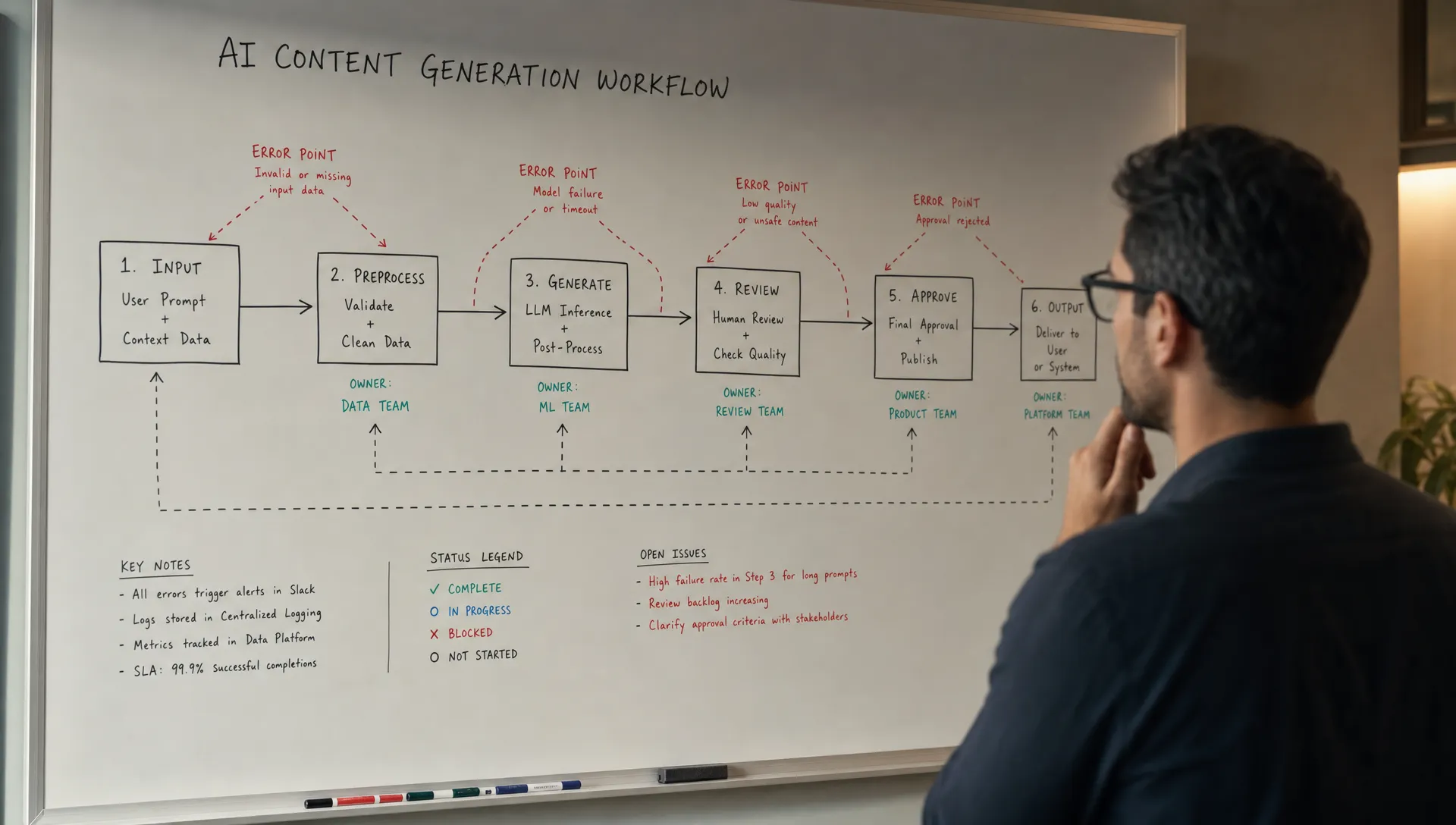
Assign the right owner to each kind of failure
The model can be the source of an error. It cannot be the accountable party. Products, teams and users need a clearer split.
A useful ownership map separates four roles:
| Role | Owns | Product implication |
|---|---|---|
| Product system | What the AI can access, change, remember and present | Show scope, limits and state clearly |
| AI output | Draft suggestions, summaries, predictions and transformations | Label outputs by confidence in workflow terms, not abstract scores |
| User | Final judgment in tasks where the user is accountable | Give review tools, source access and easy correction |
| Organization | Policy, rollout rules and acceptable use | Provide admin guidance, audit trails and escalation paths |
This is not bureaucracy. It is product design.
If the product owns context selection, do not make the user guess which inputs were used. If the user owns final approval, do not hide the evidence they need to approve. If the organization owns policy, do not bury usage rules in a help doc that nobody reads during the workflow.
NIST's AI Risk Management Framework treats accountability, transparency and governance as part of trustworthy AI. Product teams should translate that into interface decisions. Not policy posters. Actual workflow states.
Design for recovery, not perfect behavior
Many teams respond to trust failures by trying to make the AI sound more certain. That often makes the problem worse. A polished wrong answer creates more exposure than a rough draft with clear review paths.
Better design makes mistakes survivable.
Use labels that describe output state, such as "draft based on selected notes" or "ready after manager review." Show the inputs that mattered. Make missing inputs visible. Let users correct the output in place instead of restarting the prompt. Keep an audit trail when AI output affects a customer, contract, payment, compliance step or internal decision.
Most importantly, give users a graceful way to say, "this is wrong," without making them feel like they failed. A good correction loop teaches the system, improves the artifact and preserves the user's sense of control.
This is why recovery patterns matter more than generic confidence labels. If the user cannot inspect, correct or reverse a bad output, the product is asking them to absorb all the risk. The piece on why trust in AI comes from recovery, not confidence scores covers that failure mode in more detail.
A quick diagnostic for your team
Run this with one AI workflow, not your whole product. Pick the workflow where usage drops after trial or where users keep outputs in draft.
Ask these questions in order:
- If the AI output is wrong, who is expected to notice?
- What evidence does that person have inside the product?
- Who approves the output before it affects another person, system or decision?
- If the error reaches the next step, who can undo or correct it?
- What does your product log so the team can explain what happened?
- Where does the interface imply more certainty than the workflow can support?
If the team gives different answers, users are probably confused too.
The fix may be small. A draft state. A source panel. A review gate. A clearer handoff. A correction action that does not require regenerating from scratch. The point is not to add friction everywhere. The point is to put friction where accountability changes hands.
For a more structured pass, the AI Product Adoption Deck includes diagnostics, action cards and workshop templates for mapping symptoms like trust gaps, abandoned outputs and unclear handoffs into concrete product decisions.
Frequently Asked Questions
Does every AI error need a human owner? No. Low-stakes errors can be handled by the product through retry, edit or undo patterns. Human ownership matters when the output affects a decision, customer interaction, record, payment, legal claim or business commitment.
Is this just a compliance problem? No. Compliance teams care about accountability, but users feel the problem much earlier. If the interface makes them accountable without giving them control, they will avoid the feature even when no formal policy is involved.
Should we add confidence scores to solve this? Usually not by themselves. A confidence score does not tell the user what to check, who approves the output or how to recover from a mistake. Workflow evidence is more useful than abstract certainty.
How do we know if ownership is the main trust issue? Look for a gap between generation and use. If users create outputs but do not send, publish, accept or reuse them, the issue may not be output quality. It may be that nobody wants to own the consequence.
Next step
Take one high-value workflow and write the error contract in plain language: what the AI does, what the user checks, who approves, what can be undone and what gets logged. If you cannot write that contract, your users cannot infer it from the interface.