Why AI in Work Needs a Clear Owner Before Launch
AI in work needs a clear owner before launch. Diagnose ownership gaps, define decision rights and measure whether output reaches real workflows.
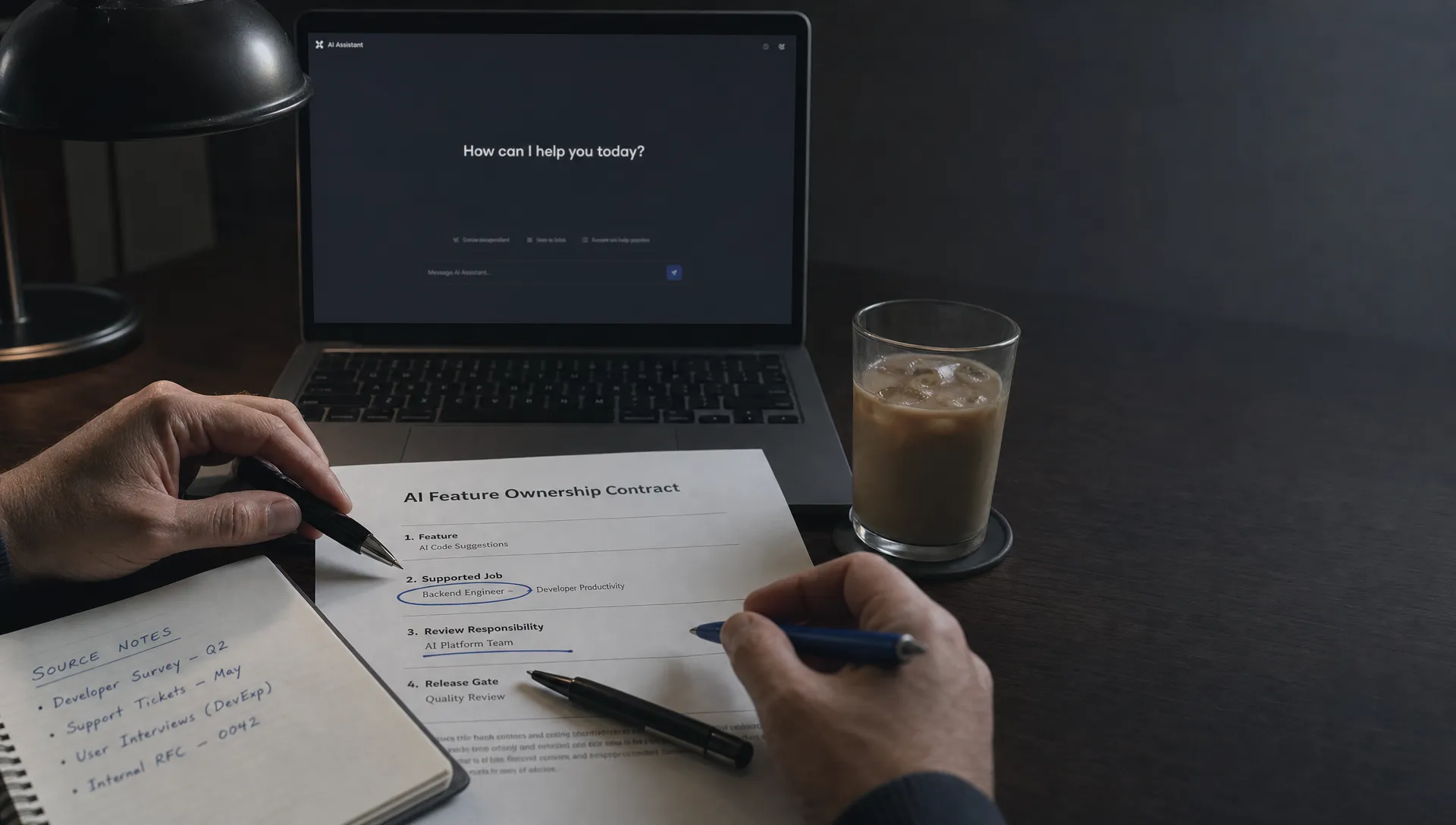
Users try the feature, generate something useful and then return to their old workflow. Sales calls it an enablement problem. Engineering points to output quality. Product wants better onboarding. Nobody can say who decides whether the generated work is ready to use. That is an ownership gap, and it can stall AI in work before a team understands what went wrong.
The gap usually starts before launch. A team assigns someone to ship the feature but nobody to own the conditions under which users can rely on it. Review expectations, release boundaries and adoption measures remain separate conversations.
If your feature is already live, use the next rollout or scope expansion to resolve this. You do not need another steering committee. You need a named decision owner with a clear remit.
AI in work needs a decision owner, not just a sponsor
A sponsor secures funding. A delivery lead coordinates the release. A decision owner is accountable for the product’s intended use: which job it supports, where its authority stops and what evidence justifies expanding access.
These can be the same person, but they are not the same responsibility.
This is distinct from deciding who owns an AI error after it reaches a user. Before an error occurs, someone must resolve conflicting expectations about acceptable use.
The owner does not approve every output. They make sure the product establishes who reviews, who acts and who can stop the workflow. Security, legal and customer administrators retain their existing authority.
Diagnose the missing decision before changing the UX
An ownership problem in AI in work often looks like weak activation or retention. The useful diagnostic is whether anyone can resolve the uncertainty behind the behavior.
Ask a PM, an engineer and a customer-facing teammate to describe the intended workflow independently. Compare their answers, not their confidence. Agreement that the feature “helps users draft faster” is not enough. They should agree on what happens after drafting.
| Observed symptom | Possible missing decision | Prelaunch response |
|---|---|---|
| Users generate drafts but rarely use them | What makes an output ready for its destination? | Define the review requirement and approved destination |
| Different teams teach different workflows | Which use case is actually supported? | Choose one initial job and document exclusions |
| Users repeatedly seek manager approval | Who has authority to use or approve the result? | Validate the approval path with the customer’s workflow owner |
| Feedback moves between teams without resolution | Who can prioritize a change to the workflow? | Give one product owner a decision path and escalation route |
| Usage rises but the team cannot explain success | Which completed work outcome counts as adoption? | Define a downstream outcome before widening access |
These symptoms are clues, not proof. Output abandonment can also reflect poor quality or excessive editing effort. Use the free Triage tool to structure the diagnosis, then check the suspected cause in actual user sessions.
Name one owner and make the remit usable
“Product owns adoption” is too vague. Name a person who can make scope decisions, negotiate dependencies and bring unresolved risks to the appropriate approver.
At a small startup, that may be the founder or CTO acting as product lead. At an established SaaS company, it may be the PM responsible for the workflow. The title matters less than the authority and available time.
For AI in work, ownership must cover the route from generation to completed work, not just the generation interface.
Write a short ownership contract before launch:
- Supported job: The task this release helps users complete, including what it does not support.
- Authority boundary: What the feature may suggest, change or execute, and what requires human approval.
- Review responsibility: The role expected to check output before it affects another person or system.
- Decision rights: What the named owner can change and which decisions need another approver.
- Release evidence: The observations that support launch, expansion, restriction or rollback.
Validate this contract with the people who perform and supervise the work. Assigning a reviewer on paper does not help if that person lacks the time, context or access to check the result.
Example: a reply assistant without a review owner
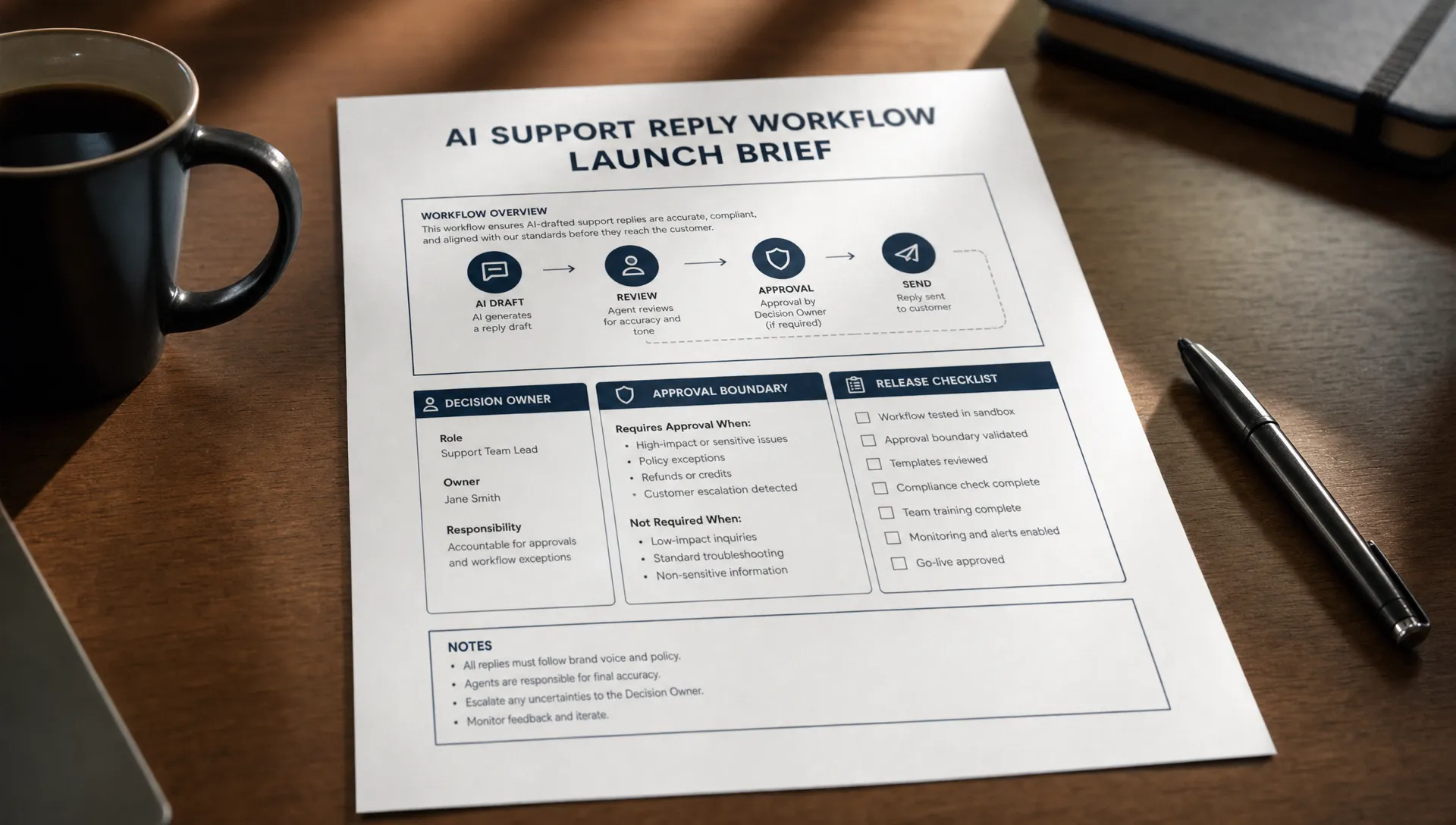
Consider a hypothetical support product that generates customer replies. The launch team agrees that agents remain “in control.” That phrase leaves several product decisions unresolved.
Can the draft include refund commitments? Must agents check policy references? Does approval happen on every reply or only for specific cases? Can a customer administrator restrict the workflow?
The feature launches with a polished draft button. Agents preview replies but continue writing manually because checking the draft feels less predictable than doing the work themselves. The team interprets low reuse as an onboarding problem.
A clear owner for AI in work would investigate the review burden before adding tutorials. They might narrow the first release to non-binding replies, make relevant source material accessible and preserve the existing send approval path. Those are decisions to test, not universal fixes.
The owner then checks whether agents actually use reviewed drafts in completed replies. If they still abandon them, the next diagnosis may be output quality or editing effort. Clear ownership prevents the team from treating every failure as the same problem.
Give the owner evidence and a launch gate
A named owner without evidence becomes the person everyone blames. Instrument the points where generated output becomes, or fails to become, real work.
For the support example, distinguish draft generation from editing, approval, sending and reuse on a later eligible task. Track these events only where you can observe them reliably. A copy action is not proof that the output was used successfully.
The owner of AI in work needs a measure tied to the supported job. For example, track the share of eligible reply tasks completed with a reviewed draft, alongside correction effort and policy issues. Compare repeat use across later eligible tasks, rather than rewarding daily usage when the job is infrequent.
Set targets against the existing workflow and its risk level. There is no useful universal acceptance threshold.
Before launch, require an explicit decision on unresolved boundaries. A reversible drafting aid may justify a limited release with close observation. A workflow that sends messages or changes records needs stronger approval and recovery arrangements. A deadline is not evidence that those arrangements exist.
Frequently asked questions
Should the PM own the AI feature? Often, if they own the underlying workflow and can make scope decisions. If they lack that authority, assign an accountable product lead rather than giving the PM responsibility without decision rights.
Does one owner replace cross-functional review? No. One person coordinates product decisions and escalates unresolved issues. Security, legal, engineering and customer workflow owners still make decisions within their remit.
What if the feature has already launched? Audit one supported job. Identify the decisions nobody owns, assign authority and review the next expansion against an explicit launch gate.
Make the next release decision explicit
Before expanding AI in work, ask three people who owns its supported use, who reviews its output and what would stop the rollout. If their answers differ, resolve that before adding another capability.
For a deeper working framework, the AI Product Adoption Deck provides 12 diagnostics, 80 action cards across 10 stacks and 12 workshops with fillable deliverables. Use it to turn the diagnosed gap into a concrete product decision, experiment or spec.