Why AI Feedback Buttons Collect Ratings but No Usable Evidence
AI feedback buttons collect opinions, not diagnoses. Capture task context, failure reasons and outcomes to improve AI product adoption.

Your AI feature has collected hundreds of thumbs-up and thumbs-down ratings. The dashboard looks informative until someone asks what to change. A negative rating could mean the answer was wrong, too long, based on the wrong document or impossible to use. For AI product adoption, those are different failures with different fixes.
The problem is not necessarily low feedback volume. It is that the feedback interaction captures a reaction without preserving enough evidence to explain it. More ratings will not repair that gap.
Why AI feedback buttons stop short of diagnosis
A rating compresses several judgments into one signal. Users may rate factual accuracy, tone, speed or whether the answer matched an unstated expectation. Your dashboard treats those votes as comparable even when they describe different problems.
That makes ratings useful for spotting something worth investigating, but insufficient for deciding what to build.
| Feedback signal | What remains unknown | Evidence that helps |
|---|---|---|
| Thumbs-down | Was the content incorrect or merely unsuitable? | Failure reason and affected passage |
| “Not helpful” | What was the user trying to accomplish? | Task context and intended destination |
| Regenerate after a positive rating | Was the answer acceptable but incomplete? | Subsequent actions and user explanation |
| No rating | Did the user succeed, leave or ignore the controls? | Observable workflow outcome, where available |
Keep the distinction between preference and performance explicit. As our article on better ratings hiding worse results explains, a favorable reaction does not establish that the output helped complete the task.
Define the evidence a product decision needs
Before redesigning the feedback panel, choose a decision it should support. “Improve quality” is too broad. “Determine why users reject generated customer replies” gives you something testable.
For each report, aim to connect five pieces of information:
- The task: What was the user trying to produce, decide or change? Use an existing workflow label where possible rather than asking them to repeat it.
- The exact output: Attach the response identifier and relevant revision so the report survives regeneration, editing and multi-turn conversations.
- The failure: Capture a reason tied to an observable problem, such as an unsupported claim or an ignored instruction.
- The expected difference: Let the user highlight a passage, describe what was missing or provide a correction when practical.
- The next action: Record whether the user edited, regenerated, applied or discarded the output, but only where your product can actually observe it.
This is an evidence contract, not a mandatory five-question form. Capture permitted context automatically. Ask the user only for information the product does not already have.
Store relevant version metadata too, including the prompt template, retrieval configuration or product variant involved. Otherwise, a report may arrive after the behavior has changed, leaving the team unable to reconstruct what happened.
Ask for the failure, not a review of the AI
“Tell us more” asks users to do your diagnostic work. A short, task-specific question gives them a better starting point.
For a generated customer reply, useful reasons might include “Invented a policy,” “Missed the customer’s question” and “Wrong tone.” A document-summary feature needs different categories, such as “Omitted a key point” or “Misrepresented the source.”
Keep an “Other” option with optional text. Review those responses regularly. If users repeatedly describe a failure your categories cannot express, revise the categories rather than forcing reports into the nearest bucket.
Use progressive disclosure
Let the initial rating remain lightweight. After a negative response, offer a reason selector. Then show a relevant follow-up: “Which claim is unsupported?” is more useful after an accuracy complaint than a generic comment box.
Do not make every field required. Users who just lost time to a bad answer should not have to file a detailed bug report before continuing their work.
Positive feedback can also reveal useful detail. An occasional optional question such as “What made this usable?” can distinguish accurate content from a helpful structure. Sample these prompts rather than interrupting every successful task.
Turn one complaint into a testable diagnosis
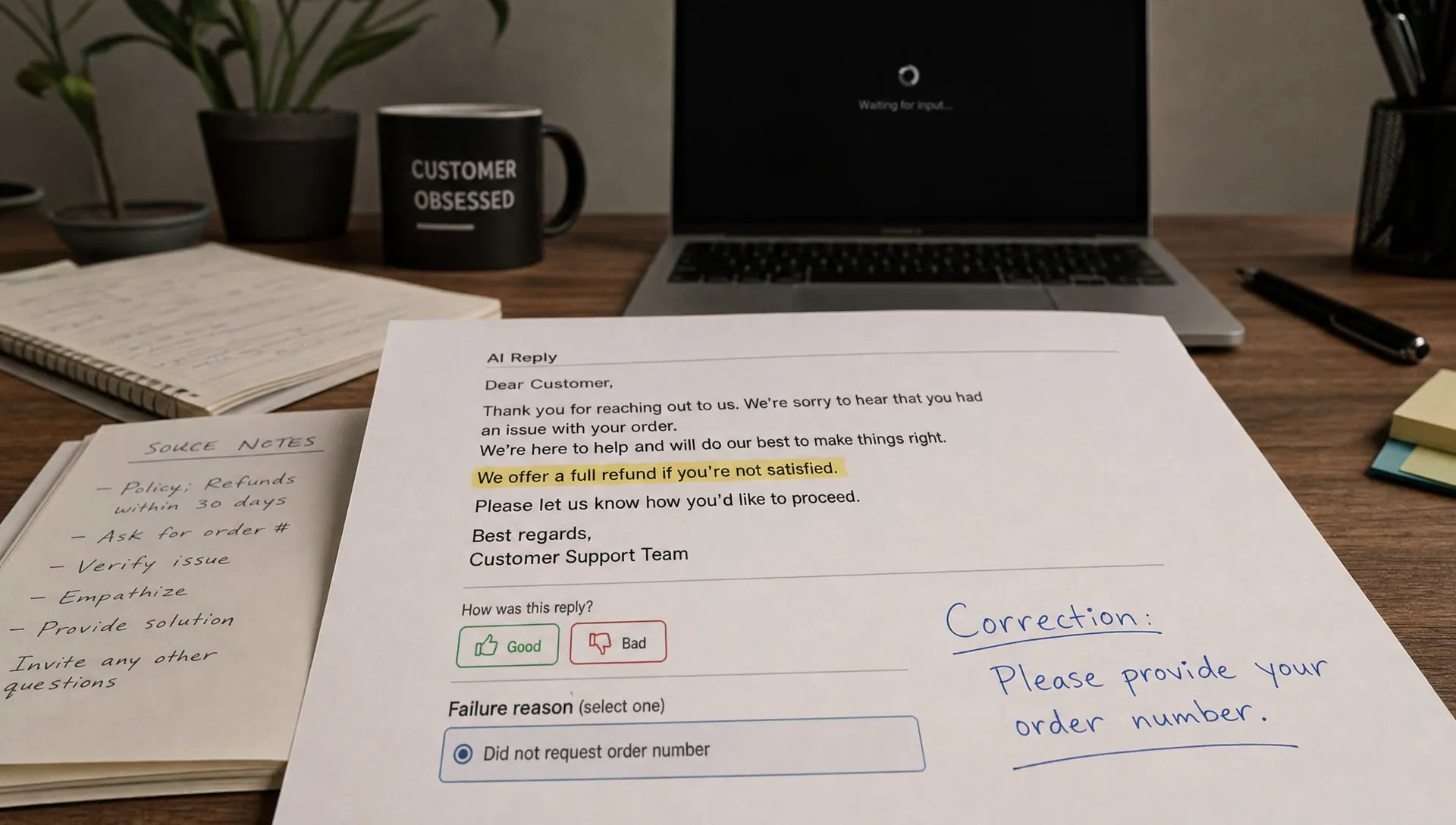
Consider a hypothetical AI assistant that drafts support replies. A user gives a response a thumbs-down and selects “Invented a policy.” They highlight a sentence promising a refund and replace it with a request for an order number.
The attached context shows that no refund policy was available to the assistant. The output nevertheless made a definite commitment.
That report supports a specific hypothesis: when policy evidence is missing, the product allows an unsupported promise instead of asking for clarification or withholding the claim.
A reasonable next experiment is to change that behavior. Test whether replies avoid unsupported commitments while still helping the agent progress. Do not stop at checking whether the revised answer receives more positive ratings.
The correction is evidence of the user’s expectation, not automatic ground truth. A reviewer still needs to check the applicable policy before treating it as an evaluation example or changing product behavior.
Make reports usable without collecting everything
Rich context can expose customer records, private documents and sensitive prompts. “Capture more evidence” should not become “store every conversation indefinitely.”
Keep report metadata separate from sensitive content. Where content capture is permitted, use a scoped, access-controlled snapshot rather than copying an entire workspace into a feedback system. Set retention rules and explain what submitting feedback shares. Ask separately for permission to contact the user when needed.
Preserve uncertainty in behavioral data too. Copying an answer does not prove it was used successfully. Closing a panel does not prove rejection. Label observed actions as actions, not inferred satisfaction.
Give every reviewed report a disposition
A weekly review needs a decision trail. Mark reports as confirmed failures, expected behavior, insufficient evidence or duplicates, with an owner and next step where relevant.
Route the underlying problem, not just the rating. A missing source may require retrieval work. A correct answer that users cannot verify may require a UX change. An ignored constraint may call for a clearer input control.
Track report completeness, time to triage and recurrence of confirmed failures. These are measures of feedback-system usefulness, not substitutes for task outcomes. Raw report counts also reflect who chooses to report and how visible the feedback controls are.
Frequently asked questions
Should we remove thumbs-up and thumbs-down buttons? Not necessarily. Keep them as lightweight entry points. Just do not treat the vote alone as a diagnosis or a measure of task success.
Should every negative rating open a required form? No. Offer a short reason selector and optional detail. Preserve the rating if the user declines to explain it.
Can user corrections become evaluation cases? Yes, after appropriate permission, privacy checks and validation. Preserve the task context and verify the correction before using it as an expected answer.
Start with ten reports, not a new dashboard
Review ten recent negative ratings. For each one, ask whether you can identify the task, locate the exact output and explain what should have happened instead. Count how many support a concrete product decision.
If most do not, fix the evidence capture before optimizing feedback volume. If the adoption symptom itself is unclear, use the free Triage tool. For a broader diagnostic workflow, the AI Product Adoption Deck provides 12 diagnostics, 80 action cards and 12 workshops for turning adoption problems into product decisions.