Product Management in AI When Better Ratings Hide Worse Results
Product management in AI needs more than better ratings. Diagnose hidden outcome regressions and build a release scorecard that catches them.

Your new AI release gets better ratings. Users call the answers clearer and more helpful. Meanwhile, more incorrect answers reach customers and the team spends longer fixing them. For product management in AI, this is a measurement failure worth catching before another rollout: users can prefer an output that makes their work worse.
The question is not whether the ratings are genuine. They may be. The question is what improved, what deteriorated and why your release criteria treated those things as equivalent.
Separate liking the answer from completing the task
A rating measures a reaction at a particular moment. If you ask immediately after generation, you mostly capture the user's first impression. You have not established whether the answer survives verification or helps finish the job.
Consider an AI assistant drafting customer support replies. A concise, confident response may earn a thumbs-up before the agent notices that it promises a refund the customer cannot receive. The customer complaint arrives later, outside the feedback window.
Three judgments need separate evidence:
- Preference: Does the user like the response?
- Task success: Does the response help complete the job correctly?
- Reliance: Does the user accept, check or challenge the response appropriately?
These can move in different directions. A polished answer can improve preference while reducing verification and increasing harmful mistakes. NIST’s Generative AI Profile identifies both confabulation and human-AI configuration as risk areas. Your evaluation needs to cover the output and how people act on it.
Product management in AI needs a task-level scorecard
Start with the outcome your feature is supposed to improve. For the support assistant, that might be resolving an eligible case correctly, with less total work and no unauthorized commitments.
Here is an illustrative example, not reported product data. Each version handles 100 comparable cases. Fifty cases receive a rating in each group.
| Measure | Previous version | New version | What it tells you |
|---|---|---|---|
| Positive ratings among rated cases | 40/50 | 45/50 | Rated outputs became more appealing |
| Cases resolved correctly | 82/100 | 74/100 | The intended outcome deteriorated |
| Cases with unauthorized promises sent | 3/100 | 8/100 | A consequential failure became more common |
The rating improvement does not cancel the outcome regression. Nor does this small example establish statistical certainty. It shows why the measures must remain separate.
Keep the denominator visible. Ratings cover respondents. Task outcomes should cover all eligible started cases, including abandonment and manual fallback. Otherwise, the difficult cases can disappear from your scorecard.
Diagnose what made the higher score possible
Do not immediately conclude that the underlying model got worse. The regression may come from how the product presents answers or changes user behavior. This is where product management in AI needs to connect output quality with the interaction around it.
Polish made mistakes harder to notice
The new response sounds decisive, removes caveats or formats every claim with equal authority. Users become less likely to check uncertain details.
Compare factual errors with verification behavior. If correctness stays flat but unchecked errors reach customers more often, investigate misplaced confidence rather than generation quality alone.
The feature shifted work downstream
Users like having a complete draft. But completing the task now requires checking more claims, repairing subtle inaccuracies or asking another team to review the result.
Measure end-to-end effort, not just generation time. A faster draft is not a faster resolution when cleanup moves to a support lead the following morning.
The people rating changed
The latest release may attract more easy tasks or retain only users who know how to repair its mistakes. An aggregate rating can rise without any comparable group improving.
Compare task difficulty, user expertise and response rates across versions. If inexperienced users struggle to assess plausible answers, the problem may be missing support for domain judgment, not poor prompting.
These mechanisms require different responses. Confidence cues will not repair a coverage gap. Better onboarding will not fix unsupported policy claims. Find the mechanism before choosing the intervention.
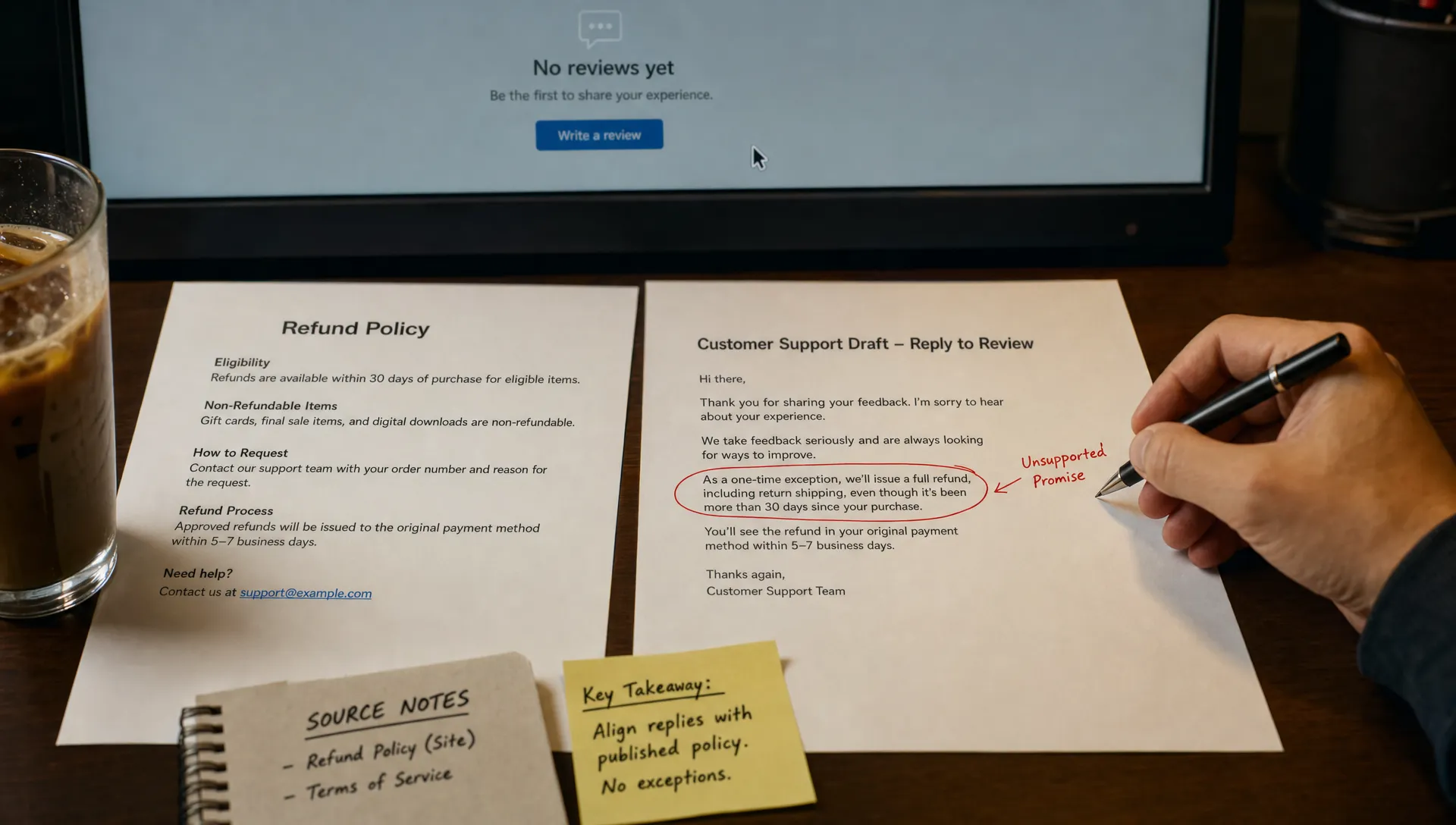
Compare releases on the whole job
A useful evaluation combines a controlled output check with evidence from actual work. Product management in AI cannot rely on either one alone: output review misses changes in reliance, while live ratings miss errors users cannot detect.
Review comparable cases without version labels
Build a case set from real tasks, including common requests, ambiguous inputs and consequential edge cases. Give reviewers the source material needed to establish correctness.
Hide the version labels. Score factual support, missing constraints and error severity separately from clarity. Otherwise, an attractive response can influence the judgment of whether it is correct.
Write the rubric before reviewing results. For a refund reply, distinguish an awkward sentence from an unauthorized financial commitment. They should not contribute equally to a release decision.
Observe what happens after generation
Where traffic permits, compare versions through a controlled rollout with randomized eligible users. Track successful completion, verification effort, corrections and downstream failures. Preserve a rollback path.
For low-volume products, use observed task sessions and independent case audits. Treat small samples as directional evidence, not proof that rare failures are absent.
Define fallback carefully. A correct manual resolution can count as job success, but it is not evidence that the AI completed the job independently. Record both outcomes so safe escalation does not conceal excessive rework.
Turn the diagnosis into a release rule
Before the next rollout, agree on what can block it. For product management in AI, a useful release rule separates the intended benefit from non-negotiable guardrails.
For the support assistant, the benefit could be lower total handling time among correctly resolved cases. Guardrails could include no unacceptable increase in unauthorized commitments and no material drop in correctness for complex cases.
Set thresholds based on consequence, baseline performance and available evidence. There is no universal acceptable error rate. A tone suggestion and a financial promise need different standards.
If ratings improve but correctness falls, investigate the changed errors before expanding access. If correctness holds but review effort rises, examine why the output became harder to verify. If aggregate performance improves while a consequential segment deteriorates, do not average that failure away.
Ratings belong on the scorecard. They should not overrule the outcome the feature exists to improve.
Frequently asked questions
Should we stop collecting thumbs-up ratings? No. They help identify preferences and cases worth reviewing. Record when the rating occurred, then connect it to task outcomes rather than treating it as proof of correctness.
Is output acceptance a better success metric? Not by itself. Acceptance can reflect useful assistance or uncritical reliance. Check whether accepted outputs remain correct after use and how much repair they require.
What if we cannot automatically measure correctness? Audit a representative sample against an explicit rubric. Include independent reviewers where consequences warrant it. Automated checks can help, but validate them against the errors that matter to your users.
Make one decision before the next release
Choose one task where ratings rose. Audit comparable cases across versions for correctness, verification effort and downstream repair. Then write down which result would stop the rollout. That is a concrete starting point for product management in AI when preference and performance diverge.
If you need help locating the break, use the free AI adoption Triage tool. For a deeper working session, the AI Product Adoption Deck is a 104-card, 124-page diagnostic playbook with 12 diagnostics, 80 action cards and 12 workshops. Use it to turn the symptom into a specific product decision, not another satisfaction target.