Why AI Disclaimers Do Not Make Products More Trustworthy
AI disclaimers rarely build trust. Learn why warnings fail, what users need instead and how to fix AI product adoption with better UX.

Users do not abandon an AI feature because the disclaimer is missing. They abandon it because the product gives them an output they cannot judge, edit or safely use. That is the trust problem behind many AI product adoption stalls, and a warning banner does not solve it.
You have probably seen the pattern. A team ships an AI workflow. Early curiosity looks decent. Users try it once or twice. Then usage flattens. Someone suggests adding clearer copy: “AI may make mistakes. Check important information.” The copy goes live. Nothing changes.
That is not surprising. A disclaimer tells users risk exists. It does not help them handle the risk.
The symptom: users read the warning and still do not trust the output
The common product symptom is not open distrust. It is quiet non-use.
Users generate the draft, summary, answer, recommendation or code suggestion. They pause. They scan it. Then they copy nothing, rewrite from scratch or go back to their old workflow. In analytics, this looks like output abandonment. In interviews, it sounds like “I just wasn’t sure” or “I’d need to check too much.”
A disclaimer cannot fix that because the user already knows the system can be wrong. The open question is narrower and more operational: can I use this output in my actual workflow without creating a mess for myself later?
That question needs product support. It needs inspectable evidence, a clear review step, scoped action and easy recovery. A generic warning gives none of those.
What disclaimers actually do to AI product adoption
Disclaimers are not useless. They can set legal, policy or safety expectations. They can remind users not to delegate judgment in high-stakes contexts. They can satisfy an internal risk review.
But they are weak adoption tools. For AI product adoption, the job is not to announce uncertainty. The job is to help the user manage uncertainty while still moving forward.
| What the disclaimer says | What the user still needs | Adoption impact if missing |
|---|---|---|
| “AI can make mistakes” | Which parts are likely to be wrong | User reviews everything or uses nothing |
| “Check important information” | Where to check and what evidence to inspect | Verification cost stays too high |
| “Use your judgment” | A safe edit, undo or approval path | User avoids the workflow |
| “Not legal, medical or financial advice” | Clear scope for acceptable use | User treats the whole feature as risky |
The core issue is that disclaimers push work onto the user without changing the product experience. They say “be careful” but do not make care easier.
Why the disclaimer feels like a product smell
A trust disclaimer often appears when the team has not made a harder product decision.
Should the AI be allowed to publish directly? Should it cite sources? Should it highlight assumptions? Should it ask for missing context before answering? Should it show diffs instead of replacing text? Should it require approval before taking action?
Those are product choices. A disclaimer is often what gets added when the choices are unresolved.
This is why users treat many disclaimers as noise. The warning sits outside the actual moment of risk. It does not attach to the claim, action or decision the user is evaluating. It does not distinguish between low-risk and high-risk output. It does not tell the user whether the model guessed, retrieved, inferred, summarized or transformed something already present.
If a user cannot tell how an output was produced, they are dealing with a black box. The better move is to expose enough of the system’s reasoning, inputs or constraints that the user can make a practical judgment. This is the same failure mode described in AI features that behave like black boxes: trust breaks when users cannot inspect what matters.
Replace vague caution with visible control
A useful AI trust pattern does not sound like a legal note. It changes what the user can see and do.
The product should answer four questions close to the output:
- What did the AI use to produce this?
- What is uncertain, missing or assumed?
- What can I accept, edit, reject or regenerate?
- What happens if this is wrong?
That is a different design brief than “add a disclaimer.” It pushes the team toward reviewable output, not defensive copy.
For example, a writing assistant should not only say “review before sending.” It should make suggested changes visible, separate tone edits from factual additions and preserve the user’s original version. A support AI should not only warn that answers may be inaccurate. It should show the source article, flag low-coverage cases and make escalation easy. A code assistant should not only remind users to test code. It should make changed lines clear and fit into the developer’s existing review loop.
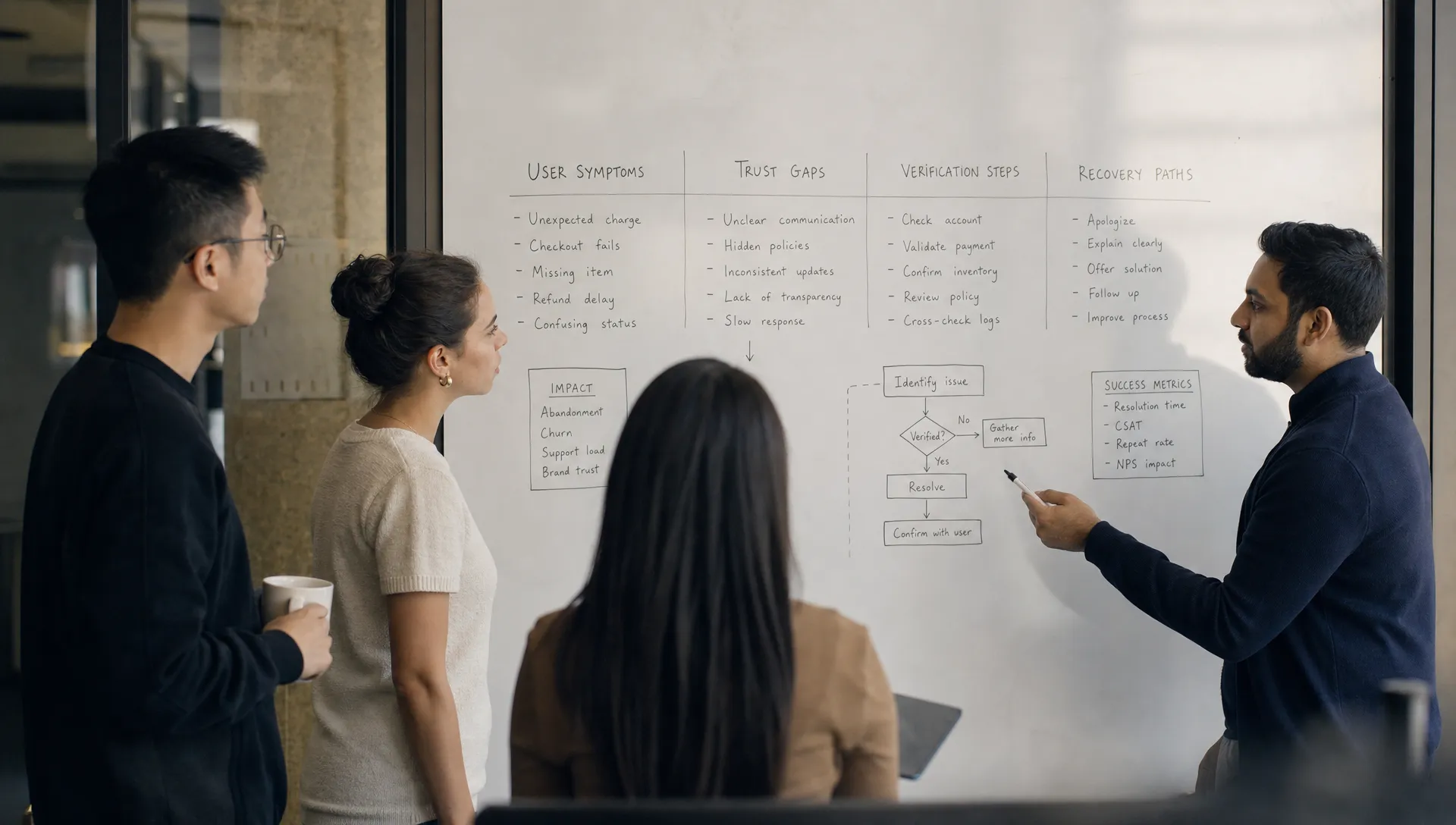
This is where many teams misread the adoption problem. They assume users want certainty. Most professional users know certainty is unrealistic. They want controlled uncertainty. They want to know where to look, what to check and how to recover if the AI is wrong.
If users need to verify output but the product gives them no fast path to do it, the issue is not trust messaging. It is inspection friction. A stronger pattern is covered in AI trust drops when users cannot check the output, especially for products where the cost of review decides whether the feature becomes a habit.
A better diagnostic: ask what the user is afraid to do
When an AI feature has a trust problem, do not start with copy. Start with the action the user is avoiding.
Are they afraid to paste the answer into a client email? Are they afraid to approve an automated change? Are they afraid the AI used stale data? Are they afraid they will be blamed for an error? Each fear points to a different product fix.
| User behavior | Likely trust gap | Better response than a disclaimer |
|---|---|---|
| Generates output but does not use it | Output is hard to verify | Add sources, diffs, claim-level checks or previews |
| Edits everything manually | AI changes are not separable | Show granular suggestions and partial accept options |
| Avoids automation | Action scope feels too broad | Add permissions, approval gates and dry runs |
| Uses feature once but does not return | Review cost exceeds value | Shorten the path from output to safe use |
| Overuses weak output | User lacks guardrails | Add constraints, stop points and clearer task fit |
This diagnosis matters because the same disclaimer can sit on top of completely different AI adoption problems. A trust gap caused by missing sources is not the same as a trust gap caused by poor recovery. A trust gap caused by unclear ownership is not the same as one caused by prompt paralysis.
For many teams, the fastest next step is to pick one high-intent workflow and watch what happens after generation. Do users inspect? Edit? Copy? Abandon? Regenerate? Ask someone else to check? The moment after the output usually tells you more than the prompt before it.
When a disclaimer is still useful
There are places where disclaimers belong. Regulated workflows need them. High-risk decisions need them. User-generated content tools may need to define responsibility and prohibited use. Internal policy may require standard language.
The mistake is treating that language as the trust system.
A good disclaimer is specific, placed near the relevant risk and paired with a control. “This summary may omit exceptions. Review the source sections before sending” is better than “AI may be inaccurate.” Better still is a summary with linked source sections, highlighted omissions and a send flow that requires review.
The copy should name the behavior you want from the user. The interface should make that behavior easy.
Trust comes from recovery, not warnings
Users do not need a product that pretends the AI is perfect. They need a product that behaves well when the AI is imperfect.
That means undo paths, version history, approval steps, easy correction, visible inputs and safe boundaries. It also means the product should learn from corrections in ways the user can understand, not silently change behavior and create a new trust problem.
This matters for AI user retention because trust is tested after the first mistake. If the user can recover quickly, they may keep using the feature. If the mistake is expensive, invisible or hard to unwind, the user remembers the risk more than the value. The product has taught them not to rely on it.
A warning does not create resilience. Recovery mechanisms do. This is why trust in AI comes from recovery, not confidence scores is a useful lens for teams stuck on trust messaging.
FAQ
Do AI disclaimers reduce user trust? Not always. A clear, specific disclaimer can help set expectations. The problem is generic warning copy that adds anxiety without giving users a way to verify, control or recover from AI output.
Should every AI feature have a disclaimer? No. Some workflows need policy or safety language. Others need better product design, such as source links, previews, edit controls or approval steps. Start with the risk in the workflow, not a blanket rule.
What should we use instead of “AI may make mistakes”? Use contextual guidance tied to the task. Tell users what to check, show the evidence they need and provide a safe next action. For example, “Review these three sourced claims before sending” is more useful than a broad warning.
How do we know if our trust issue is caused by the disclaimer or the product flow? Watch the moment after output generation. If users abandon, rewrite or seek external review, the product likely has an inspection or recovery problem. The disclaimer is probably not the main blocker.
The next product decision
If your AI feature has weak activation or poor repeat use, do not start by rewriting the disclaimer. Pick one workflow where users hesitate and identify the missing trust support: evidence, scope, control, ownership or recovery.
If you want a structured way to diagnose the break, the free AI adoption triage flow can help you map the symptom to the likely adoption problem. For teams that want to go deeper, the AI Product Adoption Deck turns these trust and retention patterns into action cards, diagnostics and workshop templates you can use with a product team.