When Cards Help AI Teams Make Better Product Decisions
Learn when cards AI teams use improve product decisions, how to diagnose adoption failures and what each review should produce.

Your AI feature gets tried, but users still finish the job somewhere else. In the product review, engineering points to output quality, design points to trust and growth wants better onboarding. Everyone has a plausible explanation. Nobody has evidence that separates them. The cards AI teams bring to this conversation help only when they turn those explanations into a testable product decision. Otherwise, they just make the meeting look structured.
Start with the disagreement, not the deck
A useful card does not start with “improve trust.” It starts with an observable break: users generate an answer, inspect it and leave without using it.
That distinction matters. “Trust” could mean users doubt the facts, cannot identify the source, fear taking responsibility for the output or simply find verification slower than doing the task themselves. Those causes require different changes.
Cards are useful when a team needs to separate three things:
- Observation: What did the user actually do?
- Interpretation: What might explain that behavior?
- Decision: What should the team change or investigate next?
Keep those separate. “Users abandon the output because they don't trust AI” combines an observation with an untested explanation. Once that explanation becomes the card's label, the team may stop looking for alternatives.
The goal is not agreement around a familiar problem. It is a decision that becomes clearer when new evidence arrives.
Match the cards AI teams use to the break
Start with the point where the user stops progressing toward a completed task. Feature-level usage is too broad to tell you which card to select.
| Observed break | Competing explanations | Evidence to collect | Decision to explore |
|---|---|---|---|
| Users open the feature but never submit | Prompt paralysis or an unclear task | Watch where users hesitate and what they try to enter | Offer a bounded task or contextual starting point |
| Users generate output but discard it | Poor output or expensive verification | Compare rejected output with the user's final work | Improve task fit or make evidence easier to inspect |
| Users edit repeatedly, then restart manually | Corrections lose context or require too much effort | Trace what changes after each correction | Preserve accepted content and make edits local |
| Users complete one task but do not return | No recurring need or a disconnected workflow | Identify the next eligible task and how users handle it | Place AI at that recurring workflow step |
These are hypotheses, not diagnoses. Repeated editing can indicate failure, but it can also be normal collaboration. Non-return can mean poor retention, but it can also mean the user has not encountered another relevant task.
The cards AI teams select should follow the observed break, not whichever metric looks worst on the dashboard. If the symptom is still unclear, the free adoption Triage tool offers a starting point for narrowing the investigation.
Use a card to challenge your favorite explanation
Consider a hypothetical account-briefing feature. Users generate a summary before a customer call, then open the original account records and write their own notes.
The team calls this a trust problem. Its first proposal is to add a reassuring message beside the generated brief.
A diagnostic card should interrupt that jump. At least two explanations fit the behavior:
The brief is wrong or incomplete. Users return to the records because the summary misses information they need.
The brief is costly to verify. The content may be useful, but checking each claim requires searching through several records.
Ask users to show what they checked and what they carried into their final notes. If they repeatedly find missing context, reassurance will not solve the problem. If the claims are useful but hard to trace, the next decision concerns evidence access rather than wording.
The cards AI teams use well make this disagreement explicit. They do not let “trust” stand in for several different failure modes. The same distinction matters when designing output users can check: the interface must support the review task, not merely explain that AI was involved.
Define the result that would change your mind
Before choosing a fix, write down what would weaken your preferred explanation.
For the account brief, the verification-cost hypothesis becomes less convincing if users can quickly locate supporting records but still reject the claims. The missing-context hypothesis becomes less convincing if users keep most of the brief once they can inspect its sources.
This is where a card becomes a decision tool rather than a discussion prompt. It needs a condition under which the team would choose a different response.
Also record what remains unknown. If your evidence comes only from first-time users, do not assume it explains repeat-use behavior. If you have watched only low-risk tasks, do not generalize to decisions where the user is personally accountable for an error.
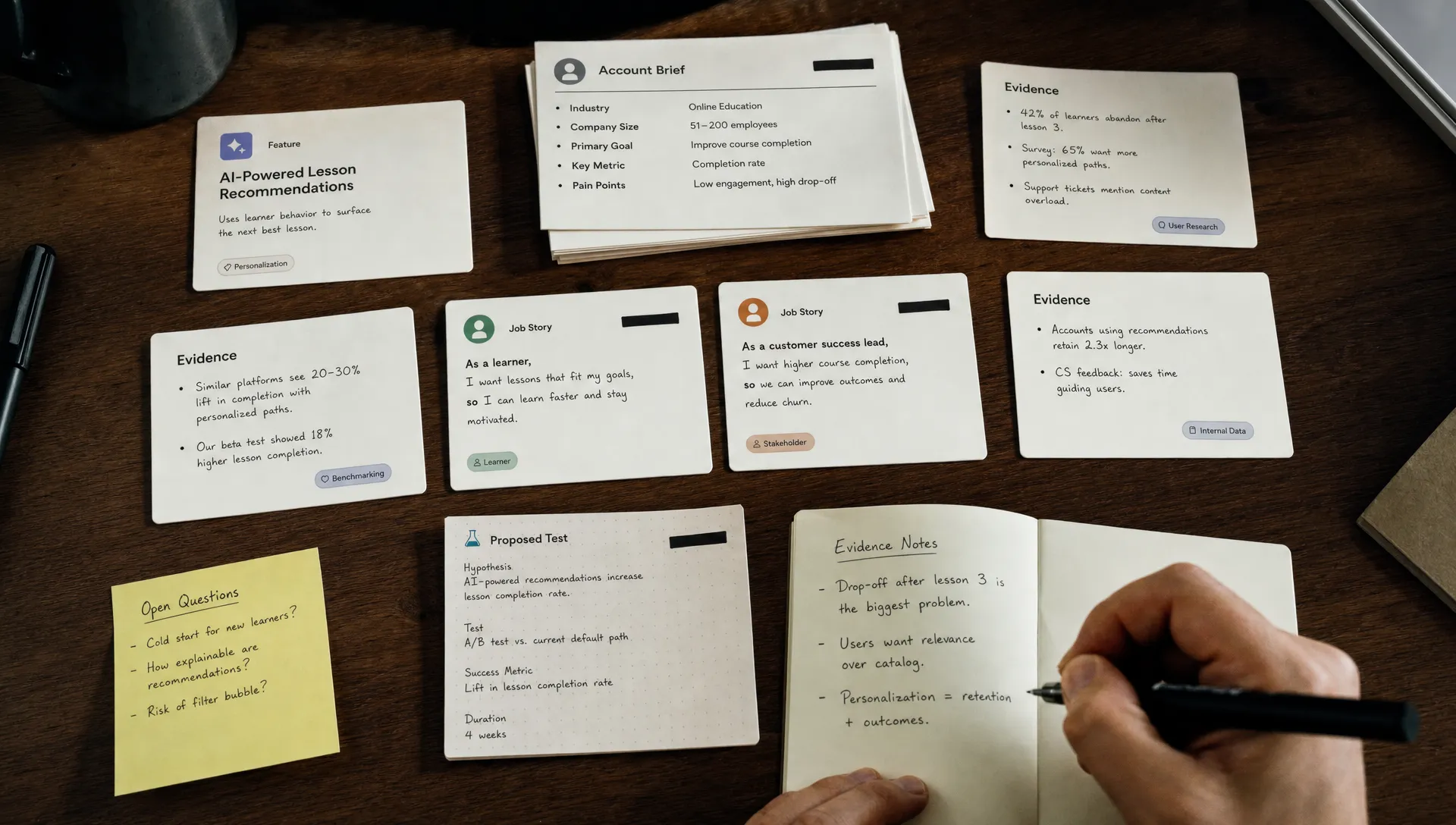
Make the review produce a product decision
A card session should end with something that can enter the team's normal delivery process. “Explore trust” is not a usable outcome.
For a 30-minute review, spend the first five minutes agreeing on the observed behavior. Use the next ten to compare explanations against actual sessions, feedback or task artifacts. Spend another ten choosing the smallest change that can distinguish those explanations. Use the final five to assign an owner and define the measurement.
The cards AI teams bring into delivery should leave behind a statement like this:
For account briefs that users currently rewrite, test claim-level links to supporting records. Measure whether users complete a usable brief with less checking effort. Also check whether they catch unsupported claims. Keep the change only if it reduces effort without weakening review quality.
That last condition matters. More accepted output is not automatically better adoption. A design can increase acceptance by making errors harder to notice.
Choose a primary measure tied to the completed task, then add a safeguard against the failure your change might introduce. For verification UX, that could mean checking both review effort and error detection. For correction loops, check both task completion and whether accepted edits survive subsequent revisions.
When cards create false confidence
Cards are a poor fit when the team lacks basic behavioral evidence. A workshop cannot tell you why users reject output if nobody has watched a rejection or inspected the final work.
They also fail when the format forces a single cause too early. Prompt paralysis and weak task fit can coexist. A user may struggle to start because the feature offers an open text box for a job that needs account context.
The cards AI teams rely on should preserve uncertainty where it changes the decision. Allow a primary hypothesis, a credible alternative and an unanswered question. Do not turn every field into a mandatory answer that someone fills with a guess.
Stop the session if the disagreement is about a missing fact. Assign a short investigation instead. And do not use cards to reopen an urgent, well-understood defect: broken source links need a fix, not a workshop.
Frequently asked questions
Are these the same as model cards? No. Model cards document a model's characteristics and limitations. Decision cards structure a product question. Model documentation can supply evidence, but it does not establish why users abandon a particular workflow.
Can cards help when the team already agrees on the problem? Yes, if the proposed response is still uncertain. Use them to specify what the change should accomplish and what evidence would make you reject it. If both the problem and response are clear, move into delivery.
How many cards should a review use? Start with one diagnostic question and only the action cards relevant to it. Bringing the whole deck into a session can encourage browsing for attractive solutions instead of resolving the observed break.
Choose one unresolved adoption decision
For your next review, bring one failed user task, two plausible explanations and one decision the team needs to make. Ask each participant what evidence would change their recommendation.
If you want a structured framework, the AI Product Adoption Deck is a 104-card, 124-page diagnostic playbook with 12 diagnostics, 80 action cards across 10 stacks and 12 workshops with fillable deliverable templates.
The cards AI teams use should earn their place by producing a clearer decision. Leave the review with an owner, a test and a condition for changing course.