When AI Credit Pricing Makes Users Afraid to Experiment
AI credit pricing can make users ration retries. Diagnose cost anxiety and test clearer charges, correction policies and spending limits.

Users open your AI feature, write a prompt, check their remaining credits and stop. Others accept a mediocre first result rather than try again. AI credit pricing may be teaching them that experimentation is waste, even when iteration is how the feature becomes useful.
That creates a misleading adoption signal. Low usage can look like weak demand or prompt paralysis. But the user may understand the feature perfectly well. They just cannot predict what a successful outcome will cost.
Before lowering the price, diagnose what users are protecting themselves from: expense, uncertainty or paying twice for the system’s mistakes.
Diagnose the pause before changing the price
Watch a complete task, including the moment before submission and the decision after the first output. Ask: “What do you expect this attempt to cost?” Then ask: “If the result needs work, what would you do next?”
Those answers help separate pricing friction from other AI UX problems.
| Observed behavior | Possible cause | What to check |
|---|---|---|
| Users hesitate before submitting | Cost is unclear | Can they predict the deduction? |
| Users accept weak first drafts | Retries feel financially risky | Do they know what revision costs? |
| Users repeatedly check their balance | Credits do not translate into tasks | Can they estimate how much work remains? |
| Usage drops within a shared workspace | Users fear spending someone else’s budget | Are individual permissions and allowances clear? |
| Users abandon outputs despite ample credits | Verification or relevance is the real problem | Can they evaluate and use the result? |
Do not treat every abandoned output as price sensitivity. If users cannot assess correctness, cheaper generation will not fix the task. Similarly, a generous balance does not eliminate anxiety when users lack permission to spend it.
Why AI credit pricing punishes normal iteration
An AI task often requires discovery. Users learn what context matters after seeing an initial result. They may need to narrow the request, correct an assumption or compare alternatives.
Charging for each attempt makes that learning visible as a loss before its value is clear.
Consider a hypothetical plan with 100 credits and a five-credit generation charge. The arithmetic is simple: 20 generations. The task economics are not. If a usable result requires one initial generation and three revisions, the user gets five completed tasks, not 20.
The useful unit is the cost of reaching an acceptable outcome, not the cost of producing an output.
This does not mean every retry should be free. It means the pricing unit and the product’s iteration model need to agree. A feature designed around repeated refinement should not present each refinement as an unexpected new purchase.
Make the next attempt financially legible
Show the charge before the commitment
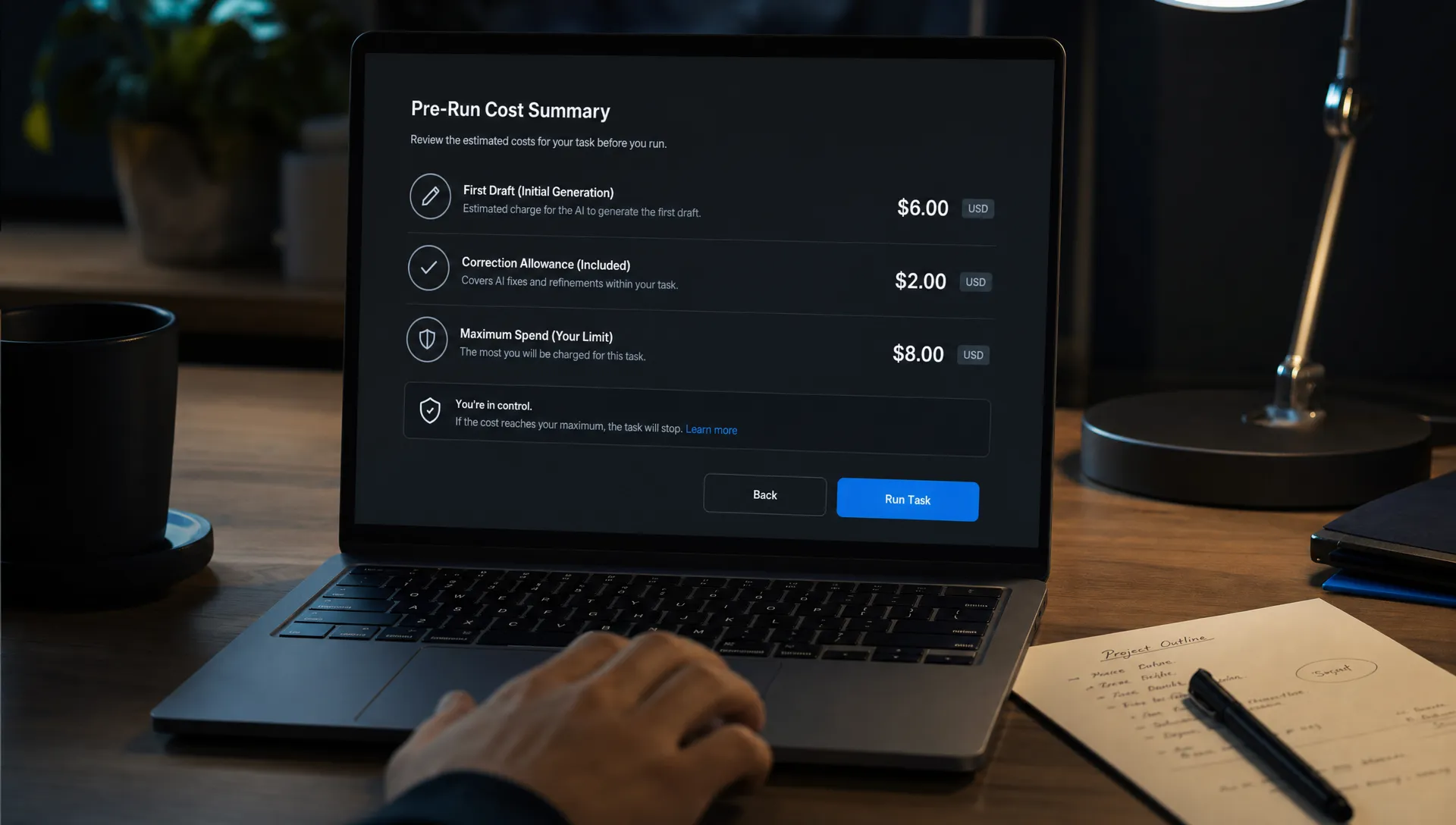
Replace an unexplained credit icon with a clear statement of what the next action will consume. For variable-cost work, show an estimate, explain what changes it and offer an enforceable spending ceiling.
A useful comparison comes from repair services. Fixed-price iPhone repairs make the quoted service cost knowable before a customer commits. AI work can be less predictable, but that strengthens the case for a bounded attempt rather than an open-ended deduction.
For an agent that may take several steps, distinguish an estimate from a hard maximum. Explain what happens at the ceiling: pause for approval, return partial work or stop. Do not label an estimate as a cap unless the product actually enforces it.
Separate corrections from new requests
A timeout, a result that violates the requested format and a request for a different creative direction are not the same event.
Define your charging policy around those differences. A candidate policy might restore credits after a system failure, include a bounded correction step for unmet instructions and charge for genuinely new work. Test the policy against your costs before committing to it.
The critical UX detail is disclosure at the point of revision. Users should not have to guess whether “fix this” spends another full allocation.
AI credit pricing becomes especially hard to trust when the system makes a correctable mistake and then charges an undisclosed amount to repair it.
Give exploration a safe boundary
A small, explicit exploration allowance can let users learn without exposing the whole balance. Other options include a preview, a lower-cost draft mode or a bounded task bundle. Each needs clear limits and an honest description of what the user receives.
For shared workspaces, separate the organization’s balance from the individual’s spending authority. A large pooled allowance can still feel untouchable to someone who does not know whether they are allowed to use it.
This is a financial version of the broader need to let users set a safe boundary. The boundary should be visible before the action, not discoverable on the invoice.
Test whether certainty improves completed work
Do not evaluate a pricing change only by generation volume. Removing friction can increase calls without increasing useful outcomes.
Start with one recurring task and one intervention. For example, test an explicit pre-run quote while keeping the underlying charge unchanged. That helps distinguish cost uncertainty from the price level itself. Test a correction allowance separately rather than changing everything at once.
Track the path from eligible task to accepted output. Define acceptance in terms of the workflow, such as exporting a draft, applying an edit or completing the downstream action. A copy event alone may not establish success.
Measure revision attempts alongside abandonment after an unsatisfactory first result. More retries can be healthy if they lead to usable work. They can also indicate that users are trapped in an expensive correction loop.
For AI credit pricing experiments, pair product outcomes with cost per completed task, refunds and support contacts about unexpected charges. Check whether users return at their next relevant task opportunity. Keep a margin guardrail so a short-term activation lift does not hide an unsustainable subsidy.
Segment results by new and experienced users, personal and shared balances, and task type. Treat differences as clues, not proof that pricing caused them.
Frequently asked questions
Are credits always bad for AI products? No. Credits can support variable-cost tasks and prepaid budgets. They become a problem when users cannot connect the balance to useful work or predict the consequences of their next action.
Should every retry be free? No. Distinguish system failures, bounded corrections and new requests. Make the charging rule clear before the user commits, then test whether the policy supports both successful tasks and viable margins.
Would unlimited pricing solve experimentation anxiety? It can remove per-attempt anxiety, but it introduces different cost risks. Hidden throttling or unclear fair-use limits can recreate the same uncertainty. Start by making the actual boundary understandable.
Choose one boundary to fix
Review one task with a new user. Ask them to predict the first charge, the cost of a correction and the maximum they could spend. Where their answers diverge from the product is your first intervention.
If you need to distinguish pricing anxiety from another adoption break, use the free AI adoption Triage tool. For a deeper team exercise, the AI Product Adoption Deck provides 12 diagnostics, 80 action cards and 12 workshops with fillable deliverable templates.
Leave the review with one concrete decision: what can the user safely try, and what will it cost?