When AI Cards Beat Docs for Product Decision-Making
Learn when AI cards beat docs for AI product decisions, especially when adoption is stuck and teams need sharper diagnosis, not more context.

You know this failure mode.
The launch doc is solid. The PRD explains the use case. The design spec covers the flow. The eval notes list known limits. The dashboard has activation, usage, and retention cuts.
Then the product review starts.
One person says the AI feature needs better onboarding. Another says the outputs are not trusted. Engineering says quality improved last sprint. Growth wants another lifecycle email. Design wants to change the empty state. Everyone has read the same docs, but the meeting still ends with: let's revisit after more data.
That is not a documentation problem. It is a decision format problem.
Docs are good at preserving context. They are weak at forcing trade-offs when AI behavior is ambiguous. AI cards beat docs when the team already has enough information to act, but cannot agree which adoption break they are solving.
The symptom: the doc is complete, but the decision is not
AI features create messy product evidence. You get prompt logs, completion rates, edit rates, support tickets, qualitative feedback, screenshots of bad outputs, model evals, sales objections, and stakeholder opinions.
A doc can hold all of that. That is useful. It can also make the problem feel more understood than it really is.
For example, a flat retention curve after launch could mean several different things:
- Users do not know when to use the AI feature.
- Users know when to use it, but do not know what to ask.
- Users generate outputs, but cannot verify them fast enough.
- Users trust the output, but the next workflow step is unclear.
- Users get value once, but the job does not repeat often enough.
A long doc lets these explanations sit next to each other. A good card forces the team to pick one working diagnosis and make a product decision against it.
That is the difference.
Docs organize information. Cards organize commitment.
What AI cards do that docs usually do not
An AI card is not a short doc. It is not a sticky note with a principle on it. In product decision-making, a useful card is a bounded decision object.
It should carry a symptom, a likely cause, a decision prompt, a constraint, and a concrete output. The card is not there to explain everything. It is there to move a team from evidence to action.
| Product question | What a doc tends to do | What a card should do |
|---|---|---|
| What problem are we solving? | Describes several possible problems | Selects one symptom to diagnose |
| What assumption matters most? | Buries it in context | Names it directly |
| What should we change? | Offers options | Forces a decision or experiment |
| Who needs to participate? | Invites readers | Structures a working session |
| What is the output? | Shared understanding | Copy, spec, test, metric, or decision |
| How does it age? | Keeps growing | Gets resolved, replaced, or retired |
This is why cards often work better in AI adoption work than another memo. The hard part is rarely explaining that AI output quality matters. The hard part is deciding whether the next product change should improve input framing, verification, editing, escalation, or habit formation.
Those are different product bets. They should not be blended into one paragraph called user trust.
When cards beat docs
Cards beat docs when the problem is behavioral, cross-functional, and close to the product surface.
If your AI feature has not shipped yet, a doc may be the right tool. You need requirements, constraints, edge cases, risks, and technical context. But once users are touching the feature, the question changes. You are no longer asking whether the system can work. You are asking why people are not coming back to it.
That is where cards help.
The problem is behavioral, not informational
Adoption problems show up as behavior. Users avoid the entry point. They type vague prompts. They regenerate five times. They copy nothing. They abandon the output. They accept a suggestion once, then never return.
A doc can report those behaviors. A card asks what they mean.
For example, output abandonment is not automatically a quality problem. It may be a verification problem. The output might be good enough, but the user cannot tell quickly. That calls for a different product response than retraining the model or rewriting the prompt.
The decision crosses functions
AI adoption breaks across PM, design, engineering, data, legal, support, and go-to-market. Each function sees a different slice.
Engineering may see model limits. Design may see unclear review states. Sales may hear trust objections. Support may see confusion around expected behavior. Growth may see weak repeat use.
A doc collects those inputs. A card makes the trade-off visible enough for the group to choose.
The output must become product work
The best cards end in a deliverable. Not a vibe. Not a principle. A deliverable.
That could be revised onboarding copy, a changed default prompt, a new review step, a confidence explanation, an experiment spec, or a metric definition. If a card does not create something the team can ship, test, or reject, it is just another discussion aid.
Where docs still win
Docs are not the enemy. Bad decision hygiene is.
Use docs for source material, durable records, detailed specs, compliance context, model limitations, and evaluation notes. If your team maintains model documentation, the useful move is to turn the notes into product decisions, not leave them as background reading. This is the same argument behind using model card AI notes as practical product inputs, rather than treating them as documents only technical teams can act on.
Some evidence needs to stay as evidence. Outside software, the distinction is obvious: batch-tested research peptide suppliers such as PeptideX Australia publish COAs because the proof has to live as a reference artifact, not as a workshop prompt. AI product teams have the same split. Evals, policies, incident reviews, and risk notes belong in docs. Cards should point to that evidence when needed. They should not pretend to replace it.
The clean operating rule is simple: use docs to store the record, and use cards to make the next decision.
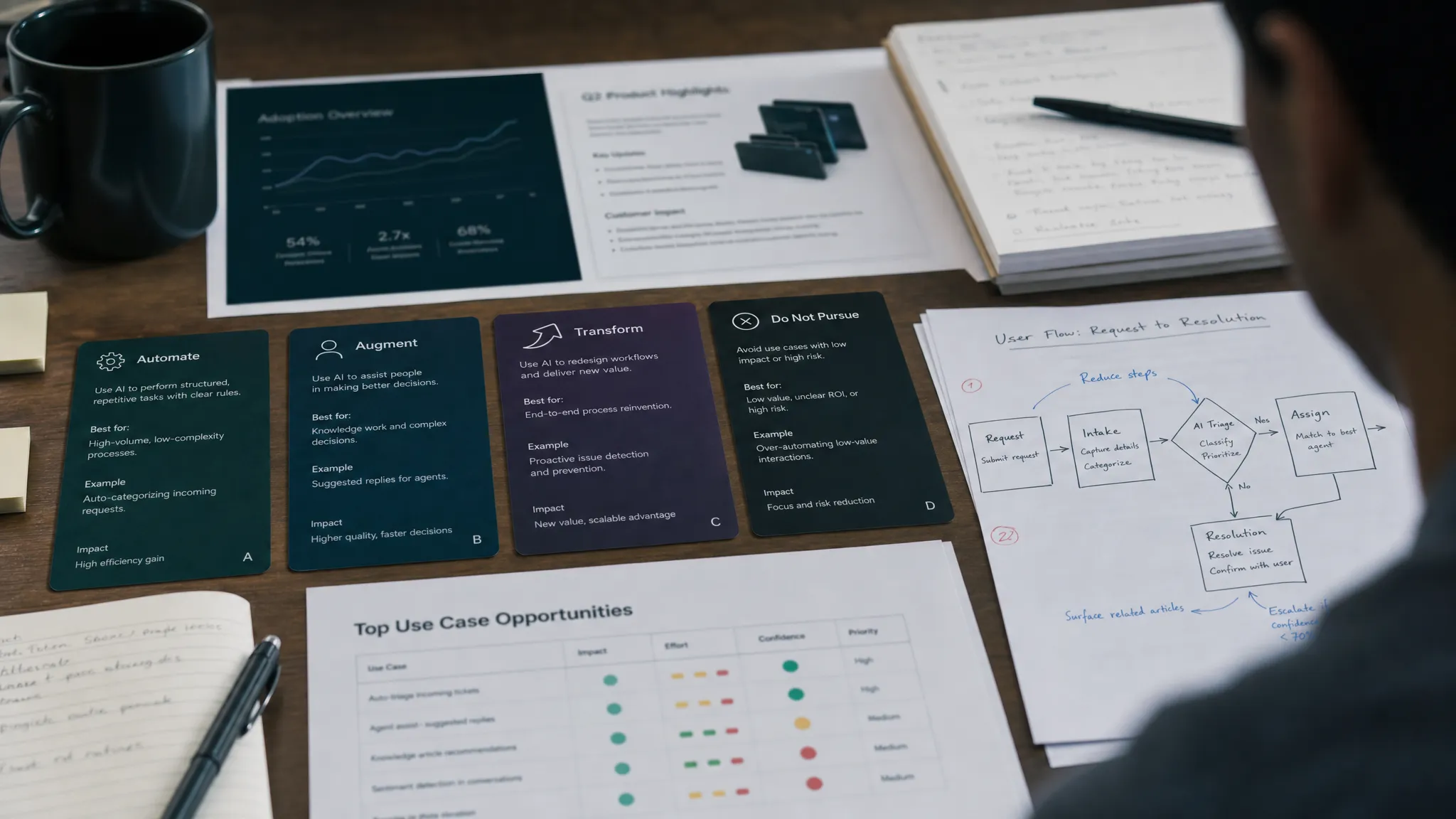
A practical split: source docs in, decision cards out
The teams that get value from cards usually do not abandon docs. They change the sequence.
First, they capture evidence in docs. Usage data, research notes, support snippets, eval results, and product constraints need a home.
Second, they choose one adoption symptom. Not five. One. If the team cannot name the symptom, the decision is not ready.
Third, they run a card against that symptom. The card should ask a narrow question, expose the assumption, and produce a product output.
Fourth, they write the decision back into the relevant doc. The doc remains the source of truth. The card is the forcing function.
This rhythm prevents the common failure where a team keeps adding context to avoid making a call.
Example: output abandonment after first use
Say your team shipped an AI account-summary feature inside a CRM. Activation looks decent. Sales reps try it during the first week. But reuse drops. Copy events are low. Reps open the summary, scan it, and write their own notes anyway.
The doc says the feature saves time. The eval report says summary quality is improving. The research notes say reps want confidence before sending account updates to managers.
A doc might lead to a broad debate about accuracy. A card should narrow the question:
| Symptom | Likely break | Decision prompt |
|---|---|---|
| Users generate but do not use the output | Verification gap | What must the user check before acting? |
| Users rewrite most of the output | Fit gap | Which parts should be editable, constrained, or prefilled? |
| Users scan but do not continue | Handoff gap | What is the next action after the output? |
| Users try once and do not return | Habit gap | What recurring trigger brings them back? |
In this case, the product bet might not be better summarization. It might be source citations, a clearer review state, and a one-click path from summary to next account action.
That is a different roadmap item. It is also a more testable one.
This is why AI product work often needs to be designed around doubt. Users are not just asking whether the output is impressive. They are asking whether it is safe, useful, and worth moving into their real workflow. If that is the pattern you are seeing, it is worth reading more on designing AI products for doubt, not delight.
What makes an AI card useful
A weak card says: improve trust.
A useful card asks: what does the user need to verify before they can use this output?
That difference matters. One creates a theme. The other creates product work.
A good AI card should include:
- The symptom it applies to.
- The user risk behind the symptom.
- The product decision the team must make.
- The evidence needed to make that decision responsibly.
- The deliverable the workshop should produce.
- The metric that will show whether the decision helped.
If a card cannot pass that test, it is probably too abstract.
The blunt rule
Use docs when the answer needs to be stored.
Use cards when the team needs to choose.
For AI product adoption, that distinction matters because the failure modes are easy to misread. A low repeat-use rate can look like a messaging problem, a model-quality problem, a workflow problem, or a trust problem. More documentation may help you describe the ambiguity. It may not help you break it.
A card gives the team a smaller room to work in. That is the point.
Frequently Asked Questions
Are AI cards just shorter product docs? No. A shorter doc still explains. A good card forces a decision, experiment, or artifact. The format matters less than the function.
Do AI cards replace PRDs, specs, or model cards? No. PRDs, specs, eval notes, and model cards are source material. Cards should use that material to guide a specific product decision.
When should a team use AI cards? Use them when the feature has shipped, the adoption signal is unclear, and the team is debating causes instead of making a focused change.
What is the biggest mistake teams make with cards? They turn them into generic principles. A card that says be transparent is not useful. A card that asks where the user needs proof before acting can change the interface.
If you want to go deeper
The AI Product Adoption Deck is built around this docs-to-decisions split. It includes 104 cards, 12 diagnostics, 80 action cards, and 12 workshop templates for teams trying to diagnose why shipped AI features are not activating, converting, or retaining.
Use it when the team does not need another opinion. Use it when the team needs a sharper way to decide what to fix next.