What an AI Index Should Measure for Product Adoption
Build an AI index that measures real product adoption: useful outputs, trust, workflow use, retention, and the exact break to fix next.

Your AI dashboard may look fine while adoption is quietly failing.
Users open the feature. They generate something. Maybe they even click thumbs up. But they do not bring the output into their real workflow. They do not come back when the same job appears again. Sales says customers are impressed in demos, but product usage flattens after the first week.
That is the problem an AI index should catch.
Not model quality in isolation. Not token volume. Not how many times someone clicked Generate. A useful AI index measures whether users are moving from AI interaction to adopted outcome. If it cannot tell you where that path breaks, it is just another activity dashboard.
The mistake: indexing AI activity instead of AI adoption
Most AI product metrics start from what is easy to instrument:
- Feature opens
- Prompts submitted
- Outputs generated
- Regenerations
- Thumbs up or down
- Token cost
- Latency
These are useful operational signals. They are not adoption signals on their own.
A user can generate ten outputs because the first nine were not usable. A user can click thumbs up because the output was interesting, then still rewrite it from scratch. A user can open the feature every Monday because their manager asked them to try it, not because it became part of the job.
The common failure is treating first contact as proof of value. If that is where your dashboard stops, you will optimize the wrong thing. This is why AI teams often need to revisit where they misread activation data before they build a new metric layer.
A better AI index starts with a harder question: did the user trust, adapt, and apply the output in the workflow they already care about?
Define the unit: an adopted AI output
Before you build an index, define the thing being counted.
For most AI features, the core unit should not be an output. It should be an adopted output.
An adopted output is an AI result that the user uses to make progress. That might mean inserting a draft into a document, sending a customer reply, committing code, updating a CRM field, using a generated brief in a meeting, or applying an analysis to a decision.
This sounds obvious. It is not how many teams measure AI.
If your product writes release notes, adoption is not the generation event. It is the release note being edited, approved, and published. If your product summarizes support tickets, adoption is not the summary appearing. It is an agent using the summary to resolve the case faster or with fewer context switches. If your product generates SQL, adoption is not query generation. It is a successful query run, reviewed, and used for analysis.
Physical products often make this clearer because the category is tied to a concrete symptom and use case. A page for compression and red light therapy for weight loss, back pain and legs, for example, anchors the product around what the buyer is trying to improve, not around the device existing. AI products need the same discipline. Measure the job and the outcome, not the presence of AI.
What an AI index should measure
A practical AI index should show the path from eligible need to repeat use. Keep the components visible. A single 100-point number is fine for executives, but PMs need to see the sub-scores.
| Index dimension | What it measures | Example signal | What a weak score suggests |
|---|---|---|---|
| Opportunity fit | Whether the AI feature appears during a real recurring job | Eligible users who encounter the AI option in-context | The feature is solving a rare or poorly placed problem |
| Input success | Whether users can provide enough context to get value | Prompt started, context accepted, low input abandonment | Prompt paralysis or unclear task framing |
| First useful output | Whether the first result is close enough to continue | Output saved, inserted, copied, or edited within the same session | Quality, framing, or expectation mismatch |
| Verification load | How much work users need before they trust the result | Time spent checking, source views, correction count, review actions | Trust gap or unclear evidence |
| Control and editing | Whether users can shape the output without restarting | Inline edits, accepted suggestions, controlled regeneration | Poor control surface or brittle interaction loop |
| Workflow application | Whether the AI output moves into the system of record | Published, sent, committed, assigned, attached, or exported | Output is useful but stranded |
| Repeat trigger | Whether users return when the same job recurs | Return usage on next eligible task, not generic DAU | No habit loop or low recurring value |
| Failure recovery | Whether bad outputs lead to repair instead of abandonment | Regenerate to accepted, correction submitted, manual fallback completed | Users do not know how to recover from AI mistakes |
This table is not meant to be copied blindly. The exact events depend on your product. The point is the sequence.
An AI index should not ask only whether the model responded. It should ask whether the user crossed each adoption threshold.
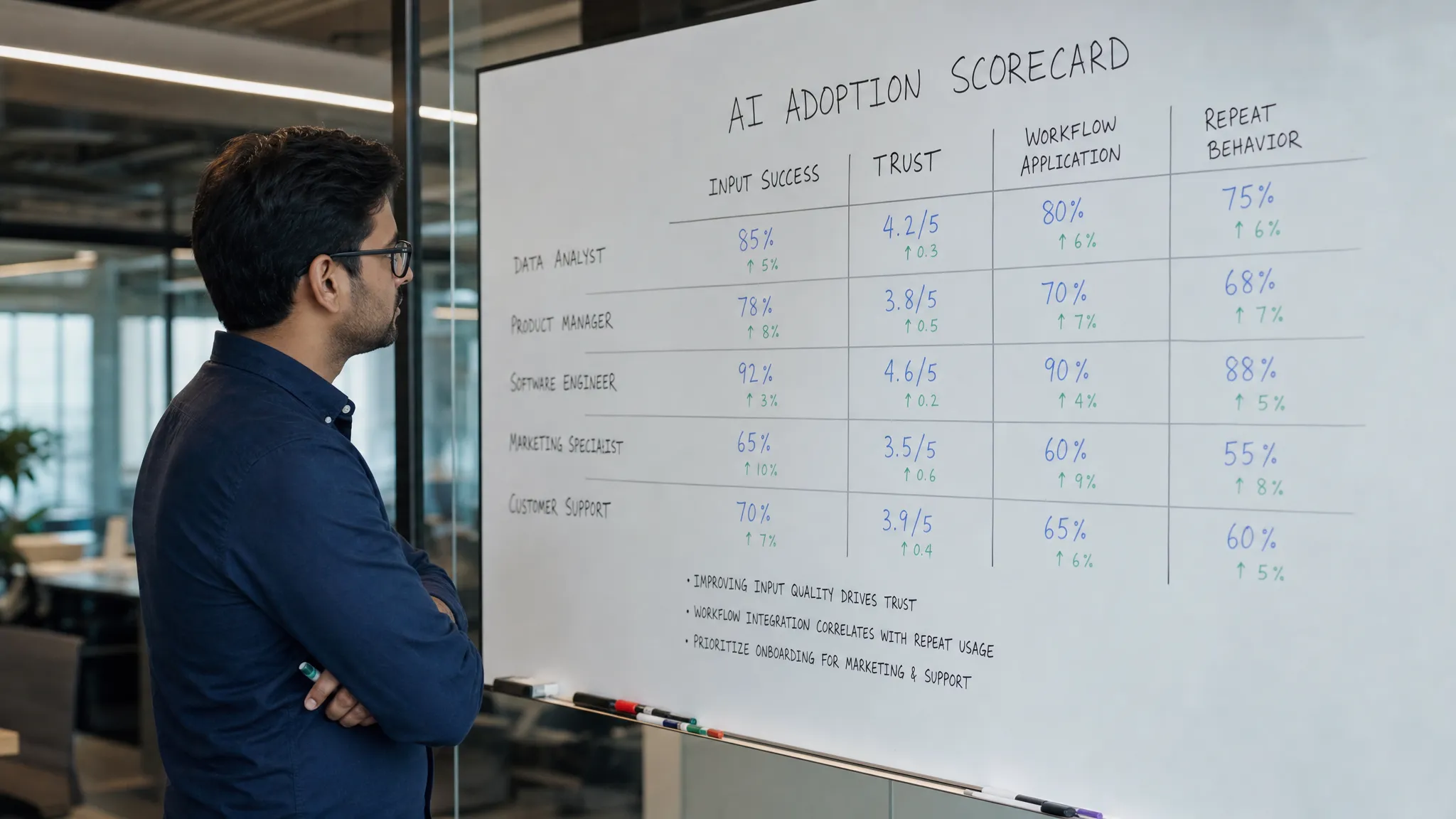
The four breaks your index should expose
A good index does not just report a score. It points to the break.
1. The input break
Users want the outcome, but they do not know what to ask for.
You see feature opens, cursor focus, maybe a few short prompts, then abandonment. The model may be fine. The product is asking the user to become a prompt designer before they get value.
Your index should separate input abandonment from output rejection. Those are different problems. Input abandonment calls for better defaults, suggested tasks, scoped templates, contextual prefill, or a narrower starting point.
2. The trust break
Users get an output, but they do not know whether to rely on it.
You see high generation, high viewing, low application. Users may copy parts into another tool, ask a teammate to check, or rewrite manually. The issue is not always accuracy. Sometimes the output gives no evidence, no confidence boundary, and no easy way to verify what changed.
Your index should measure verification behavior. If users spend more time checking than doing the task manually, adoption will not hold.
3. The control break
Users see potential, but they cannot steer the result.
This often shows up as repeated regeneration. Teams misread this as engagement. It may be frustration. If every correction requires a new prompt, the user loses the thread. The product turns editing into negotiation.
Your index should distinguish healthy refinement from loop failure. A few targeted edits can mean the AI is useful. Five full regenerations followed by no application means the interaction is broken.
4. The workflow break
Users like the output, but it does not land where work happens.
This is common in AI side panels and standalone assistants. The output is good enough to admire, but not easy enough to use. It sits outside the object, record, document, ticket, pull request, or customer thread where the job continues.
Your index should measure downstream application. If outputs are viewed but not inserted, sent, committed, attached, or saved to the right place, you do not have an intelligence problem. You have a workflow fit problem.
Do not hide bad adoption inside a blended score
Composite metrics are dangerous when they average away the break.
Imagine this index:
| Dimension | Score |
|---|---|
| Opportunity fit | 82 |
| Input success | 76 |
| First useful output | 71 |
| Verification load | 34 |
| Workflow application | 29 |
| Repeat trigger | 22 |
The blended score might look like 52. That sounds mediocre. The actual diagnosis is sharper: users reach the output, but they do not trust or apply it. The next product move is not more onboarding at the top of the funnel. It is better evidence, clearer boundaries, easier review, and tighter workflow insertion.
This is why your AI index should be read like a funnel with diagnostic layers, not like a brand health score.
Segment the index by task risk
Not all AI adoption problems are equal.
Users will accept lower confidence for low-risk drafting. They need stronger verification for legal, financial, medical, security, or customer-facing work. A generic AI index hides this difference.
Segment at least by task type and risk level:
| Task type | User tolerance | Adoption signal that matters most |
|---|---|---|
| Drafting | Moderate imperfection is acceptable | Edited output published or shared |
| Analysis | Reasoning must be inspectable | Evidence checked and decision recorded |
| Automation | Errors are costly | Human review passed and action completed |
| Recommendation | User needs confidence and control | Recommendation accepted with rationale viewed |
| Coding | Correctness is tested quickly | Code accepted, run, committed, or reverted |
The same metric can mean different things across tasks. Heavy editing in a writing product may be normal. Heavy editing in a structured data extraction product may mean failure. Regeneration in creative exploration may be healthy. Regeneration in customer support may mean wasted time.
What to exclude from the core AI index
Some metrics belong in your operating dashboard, but not in the core adoption index.
Latency matters, but only because it affects continuation. Cost matters, but it is a business constraint, not user adoption. Model benchmark scores matter for evaluation, but they do not tell you whether users can apply the output in your product. User satisfaction surveys can help, but they are too blunt to diagnose the break alone.
Keep them nearby. Do not let them replace behavioral adoption metrics.
A simple rule: if the metric cannot explain a user moving closer to or farther from an adopted output, it is not part of the core AI index.
How to build the first version in a week
Do not start with a perfect data model. Start with the adoption path.
Map one high-value AI workflow from trigger to repeat use. Pick the task where adoption matters most. Then instrument the smallest set of events that prove movement through the path:
- Eligible moment occurred
- AI feature was shown in context
- User started input or accepted prefilled context
- Output was generated
- Output was edited, verified, or corrected
- Output was applied in the workflow
- User returned on the next eligible moment
Then review five to ten real sessions for each drop-off. The numbers show where adoption breaks. The session review shows why.
If you are not sure which break you have, use the free AI product triage tool to narrow the symptom before changing the product.
FAQ
What is an AI index for product adoption? An AI index is a structured set of metrics that measures whether users move from AI interaction to real workflow adoption. It should track input, output usefulness, trust, control, application, and repeat use.
Should an AI index include model quality metrics? It can include model quality as a supporting signal, but model quality should not be the center of the index. Product adoption depends on whether users can understand, trust, edit, and apply the output.
Is output generation a good AI adoption metric? Output generation is an early activity metric, not an adoption metric. It becomes meaningful only when connected to downstream behavior, such as saving, sending, publishing, committing, or using the output in a decision.
How often should product teams review their AI index? Review it weekly while the feature is still forming. For mature features, review it by cohort and task type. The most important view is not total usage, but whether users return when the same job appears again.
The next decision
Your AI index should make the next product decision obvious.
If users do not start, fix task framing. If they start but abandon input, reduce prompt work. If they generate but do not apply, fix trust and workflow fit. If they apply once but do not return, inspect the repeat trigger and the cost of using the feature again.
That is the point of an index: not reporting that AI adoption is low, but showing where it is low.
If you want a deeper diagnostic structure, the AI Product Adoption Deck breaks these patterns into diagnostics, action cards, and workshops your team can use to turn the index into product decisions.