How to Test Whether AI Suggestions Anchor User Decisions
Test whether AI suggestions anchor user decisions. Separate useful advice from overreliance with controlled experiments and decision-quality metrics.

Your AI suggestions get accepted. Users finish faster. Then a review finds that their decisions follow the recommendation even when the underlying evidence points elsewhere. The acceptance dashboard looks healthy, but it may be measuring compliance rather than useful assistance.
To test whether AI suggestions anchor user decisions, you need more than an acceptance rate or a usability interview. You need to vary the suggestion while holding the evidence constant, then measure whether decisions move with it and whether that movement helps.
Diagnose the behavior before calling it anchoring
Anchoring happens when an initial value or position pulls subsequent judgment toward it. In an AI workflow, that starting point might be a proposed price, risk score, candidate ranking or first draft.
But accepting a recommendation is not automatically anchoring. The suggestion might be correct. A user might reasonably delegate a low-stakes judgment. Automation bias, relying too readily on automated advice, can also overlap with anchoring.
Your first question is whether the suggestion changes the decision independently of the evidence. Your second is whether that change improves or weakens the result.
A controlled test can establish recommendation-driven influence. It will not, by itself, cleanly separate every psychological mechanism behind that influence. Keep the claim narrower than the data.
Build a test that separates evidence from suggestion
Choose one bounded decision
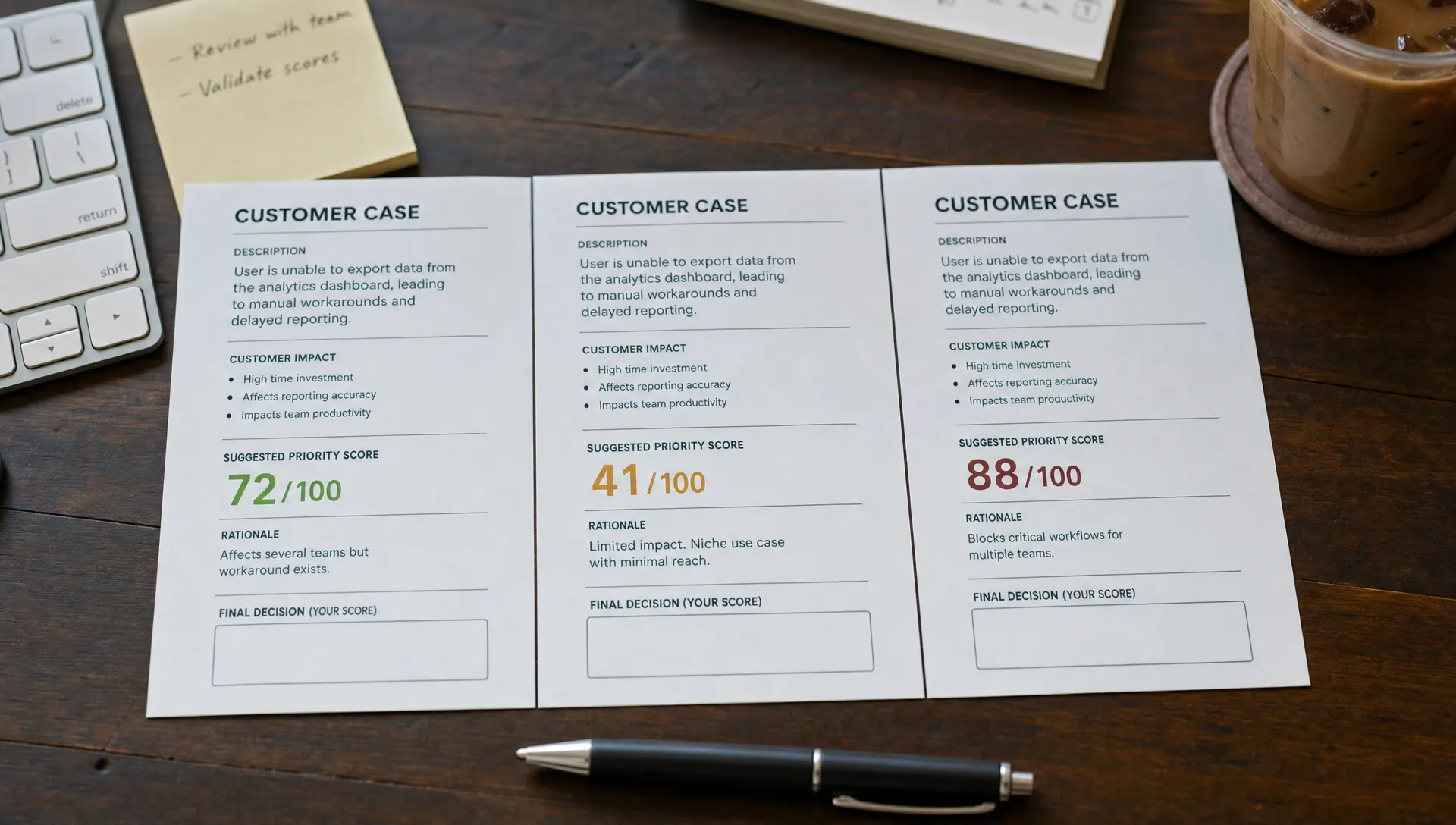
Test a task with a clear decision point, not an entire onboarding journey. For example, ask support leads to assign an escalation priority from 0 to 100 using a fixed customer case.
Keep the case details, available actions and decision scale identical across conditions. Use synthetic or de-identified cases in a sandbox. Deliberately misleading recommendations should not affect real customers.
Before testing, define what a defensible decision looks like. For tasks with a correct answer, use that answer. For judgment-heavy tasks, have independent reviewers establish an acceptable range using an explicit rubric, without seeing the AI suggestions.
If reviewers cannot agree on what makes a decision better, you can measure influence, but should not claim to have measured harm.
Compare three exposure conditions
Randomly assign participants to a workflow:
| Condition | What the participant sees | What it helps test |
|---|---|---|
| No suggestion | Case evidence, then a final decision | Unassisted decision quality and completion time |
| Suggestion first | Evidence and AI recommendation before deciding | Influence under the current assisted workflow |
| Judgment first | Evidence, a recorded provisional decision, then the recommendation and final decision | Whether forming an independent view changes susceptibility |
Do not ask suggestion-first participants for an initial answer before showing the recommendation. That would turn them into judgment-first participants and change the behavior you meant to observe.
The judgment-first condition adds effort as well as changing sequence. If you need to isolate the effect of making an initial judgment, add a time-matched comparison condition rather than attributing everything to timing.
Vary the recommendation, not the case
Within each assisted condition, randomly show a higher or lower recommendation for the same case. Choose values that are plausible enough to receive consideration, with their quality assessed against your rubric.
Keep the evidence display, wording, visual prominence and source label consistent. Avoid changing the explanation alongside the recommended value. Otherwise, users might be responding to different arguments rather than different anchors.
If final decisions shift upward when the randomly assigned recommendation shifts upward, despite identical evidence, you have evidence of recommendation-driven influence. Compare that shift with decision quality before calling it a product failure.
Protect the experiment from easy confounds
Use several representative cases. One ambiguous case can produce an impressive-looking result that says little about the workflow.
Assign exposure conditions at the participant level where practical. Within each group, balance case order and recommendation variants. Do not show someone the same case twice with different suggestions. They may remember their answer or infer the test.
Recruit actual decision-makers, including less experienced users. Record task expertise separately from familiarity with AI tools. An average can hide a serious problem concentrated in one group.
Before collecting the main results, specify your primary metric, acceptable quality loss and analysis plan. Use pilot variability to plan sample size. If participants complete multiple cases, account for those repeated observations rather than treating every decision as independent.
Measure decision movement and decision quality separately
Acceptance is a secondary metric here. A user can edit a recommendation substantially and still remain pulled toward its starting point.
For numeric decisions, compare the mean final score under higher versus lower suggestions for identical cases. That difference estimates sensitivity to the recommendation. In the judgment-first group, also measure how far participants move from their provisional answer toward the suggestion.
Pair those measures with outcomes:
- Decision quality: Accuracy, rubric score or distance from an acceptable range, compared with the no-suggestion condition.
- Error acceptance: How often users follow a recommendation that conflicts with a predefined, decision-critical fact.
- Confidence calibration: Whether confidence tracks decision quality, especially after flawed advice.
- Task cost: Completion time and effort, so a quality improvement is not evaluated without its cost.
Keep behavioral measurement separate from explanation. Asking users to think aloud can prompt scrutiny they would not normally apply. Collect the decision first, then ask what evidence mattered and what would have changed their answer.
Interpret the pattern, not just statistical significance
A measurable shift toward AI advice is not necessarily bad. The recommendation exists to influence the decision. The problem is influence that does not track evidence or worsens outcomes.
| Observed pattern | Working diagnosis | Next test |
|---|---|---|
| Decisions shift and quality improves | Advice is useful on the tested tasks | Check harder cases and important user segments |
| Decisions shift and quality declines | Harmful reliance on the recommendation | Test judgment-first sequencing or evidence inspection |
| Judgment-first reduces errors but adds substantial effort | Independent judgment helps at a cost | Test it only for consequential decisions |
| Confidence rises while quality falls | The interface may encourage unwarranted certainty | Test presentation changes and measure calibration again |
Do not prescribe friction everywhere from one result. Preserving the user’s judgment is a design goal, but the intervention should match the observed failure.
Research offers a useful starting point: Buçinca, Malaya and Gajos’s study of cognitive forcing functions found that interventions requiring more deliberate engagement could reduce overreliance. That supports testing such interventions, not assuming they will work in your workflow.
Frequently asked questions
Can a standard A/B test prove anchoring? Only if the manipulation and measurements support that claim. Comparing two button labels or acceptance rates does not establish that a starting recommendation pulled judgment away from the evidence.
What if there is no objectively correct answer? Measure recommendation sensitivity and consistency with predefined criteria. Describe the result as influence unless you have a defensible basis for judging decision quality.
Should we remove suggestions if users follow bad advice? Not automatically. First test whether changing exposure timing or requiring inspection of critical evidence reduces errors without making the workflow impractical.
Make one decision from the result
Write the decision rule before running the study: “We will keep suggestion-first only if it improves task performance without exceeding our predefined quality-loss threshold.” Specify that threshold for your domain rather than borrowing one.
If the symptom is still unclear, start with the free Triage tool. For structured team follow-through, the AI Product Adoption Deck provides 12 diagnostics, 80 action cards and 12 workshops in a 104-card PDF.
The immediate deliverable is smaller: one tested decision, one quality threshold and one interface change you can justify.