AI Inputs Fail When Users Must Gather Context Manually
AI inputs fail when users must gather context manually. Diagnose preparation costs and design context flows that lead to usable output.
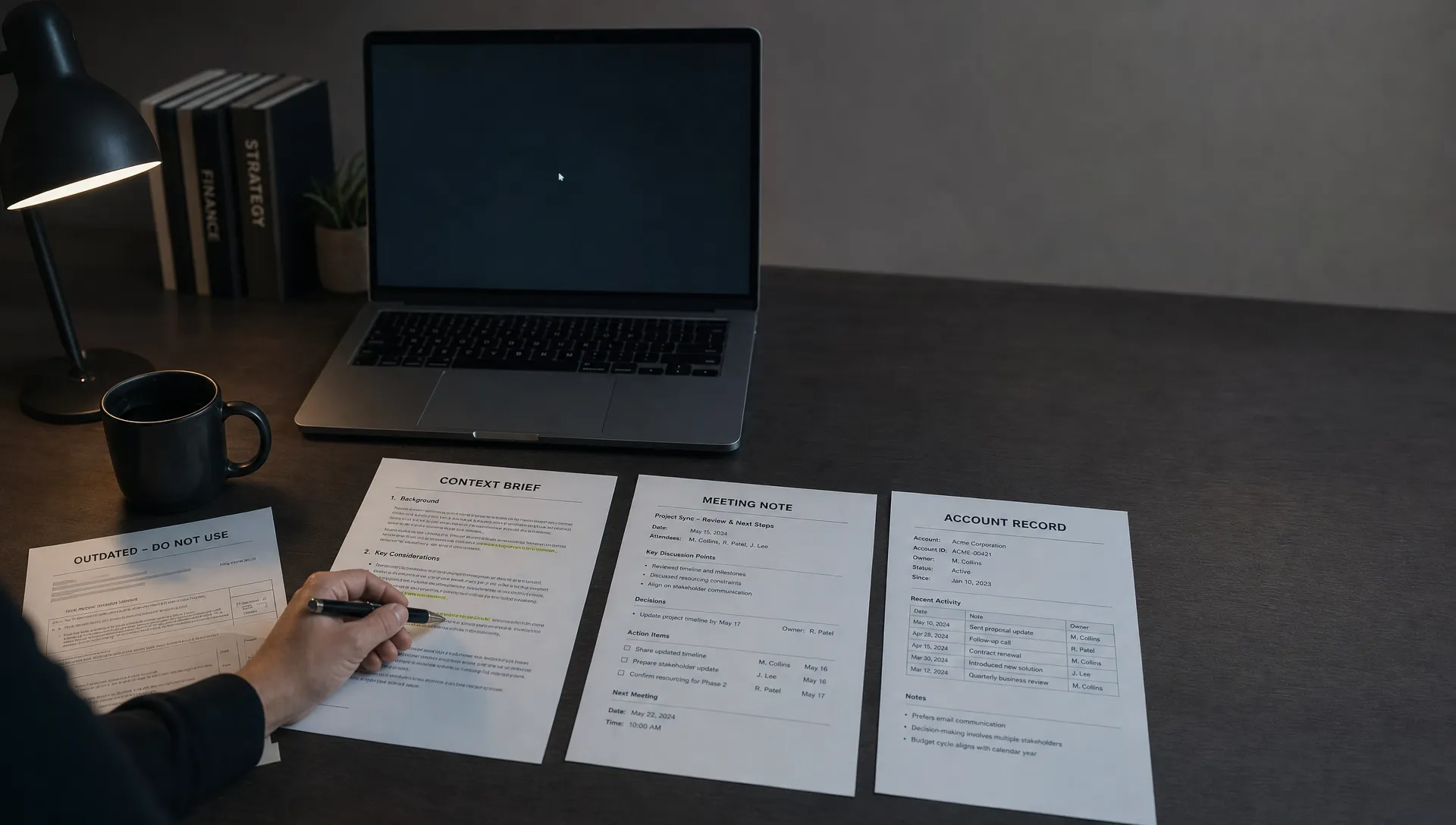
Users open your AI feature, then leave to find an account record, copy a document and reconstruct what happened in the last meeting. Some return and generate something useful. Others never submit. Your AI inputs may be costing more effort than the task they are supposed to simplify.
This is not necessarily prompt paralysis. The user knows what they want. The product has made them responsible for gathering everything it needs to help.
Locate the drop-off before generation
A generation funnel often starts too late. It records prompt submission, output delivery and acceptance. It misses the preparation work between opening the feature and pressing submit.
Watch users attempt one real task using their own materials. Ask them to narrate where each piece of context comes from. Count source switches, copy-and-paste steps and searches for missing information. Do not treat every pause as confusion about what to type.
| Observed symptom | Possible cause | Diagnostic check |
|---|---|---|
| Users leave before submitting | Context gathering costs too much | Observe which sources they open |
| Users paste long document bundles | They cannot identify relevant context | Ask which passages actually matter |
| Outputs are generic despite a clear request | Necessary task context is missing | Compare supplied context with task requirements |
| Users repeatedly correct factual details | Inputs are stale or incomplete | Trace corrections back to source records |
These are hypotheses, not conclusions. Leaving the feature could also mean an interruption. Pair event data with observed sessions before changing the flow.
The key distinction is whether users are choosing an outcome or assembling a briefing packet. Those are different kinds of work.
Make AI inputs a product responsibility
Treat context preparation as part of the feature, not as a prerequisite users must solve elsewhere. Start with one recurring task and define a context contract: what the product needs, where it comes from and what the user must confirm.
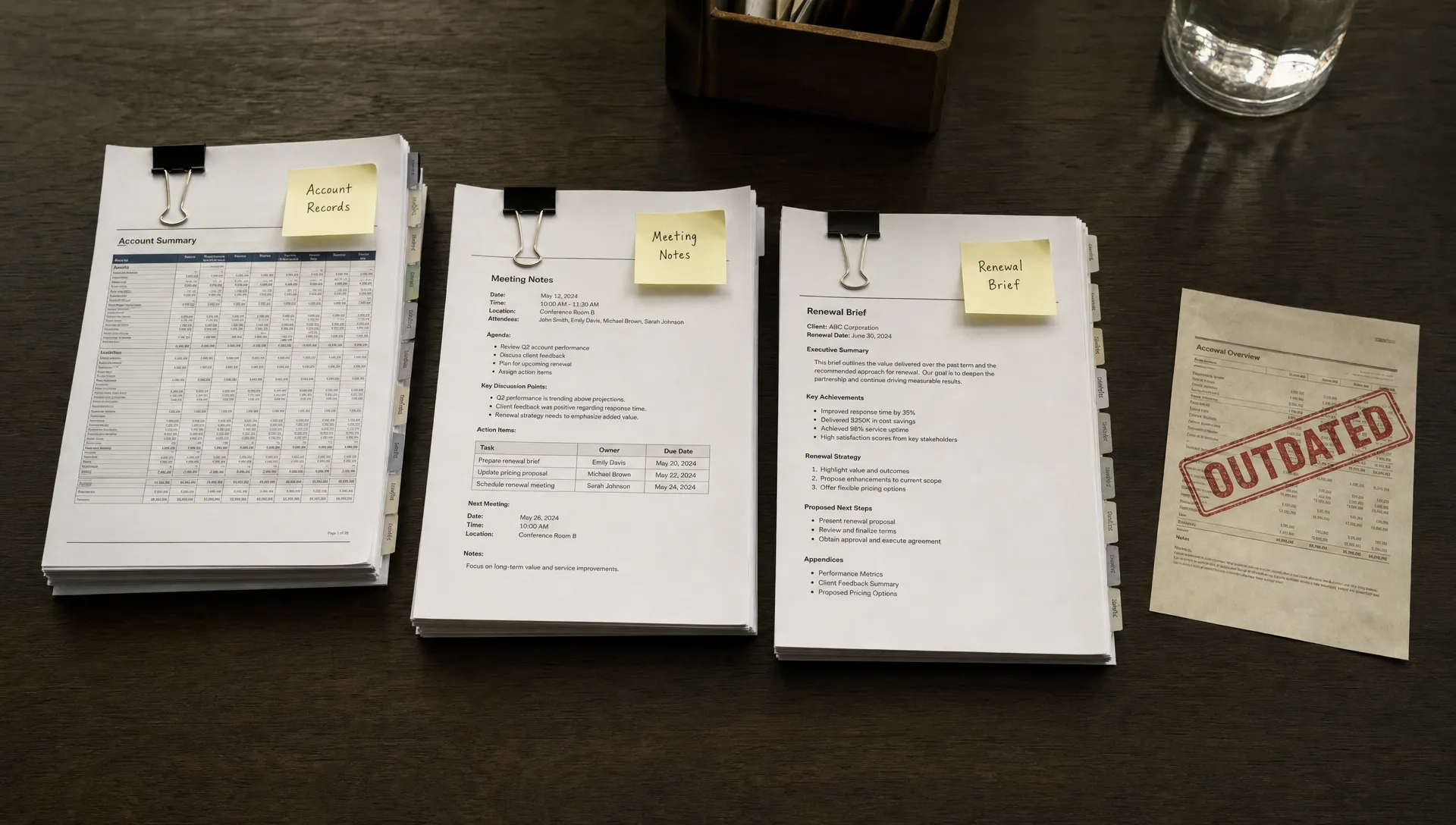
For example, suppose your feature drafts account renewal briefs. “Describe the account” transfers the entire preparation job to the user. A better design proposal starts from the selected account and identifies the records needed for that particular brief.
Write the contract in four parts:
- Required context: Account identity, renewal date, current plan and documented risks.
- Relevant sources: Authorized account records and user-selected recent correspondence.
- User judgment: The purpose of the brief and any relationship nuance absent from the records.
- Missing-data behavior: Flag unknown information rather than inventing an account narrative.
This is a product specification, not a promise that every source can be connected. If a source is unavailable, make the fallback explicit and narrow the requested input.
Automatic gathering also needs limits. Users should understand what the feature can access and exclude. Defining safe boundaries around AI access prevents reduced preparation effort from becoming a new trust problem.
Ask only for information that changes the result
Not all AI inputs deserve a field, an upload or a connector. For each requested item, name the output decision it changes. If nobody can explain the connection, remove it from the required path.
A renewal date changes urgency. A documented unresolved issue changes the risk summary. An entire archive of unrelated correspondence may add work without improving the brief.
Separate required context from optional enrichment. Let users proceed without optional material, while showing the limitation that follows. “No recent correspondence selected, so this draft uses account records only” is more useful than a generic request for more detail.
Keep genuinely human information human. A relationship concern that exists only in the account manager's head needs a focused question. It does not justify making that person manually re-enter facts already stored in the product.
Make gathered context inspectable
Removing copy-and-paste work is not enough. Users need to know whether the feature gathered the right material.
Show a compact source summary before generation: selected account, included records, source dates and any missing required information. Allow users to remove an irrelevant source or replace an outdated one without restarting the task.
AI inputs should be inspectable at the level where mistakes occur. “Three documents attached” is insufficient if one belongs to the wrong customer. Show identifying details that help the user detect that mismatch.
Freshness matters too. A current account balance and a six-month-old meeting note should not appear equally current. Preserve source dates and make conflicting records visible rather than silently choosing a value.
After generation, carry relevant source references into the output. Otherwise, users may have to repeat the same context search just to verify the draft. You have saved effort at the start and reintroduced it at the end.
For recurring work, reuse stable context only when its scope is clear. Refresh changing records and let users correct the selection. A saved setup should reduce repeated preparation, not preserve yesterday's mistake.
Test preparation cost, not just prompt completion
Run a focused experiment on one task with a predictable context requirement. Compare the existing manual flow with a version that prepares authorized context and lets users confirm or edit the selection.
Keep the intended output and generation behavior as consistent as possible. Restrict the comparison to tasks where equivalent source material is available. Otherwise, a better result could reflect better data rather than a better preparation experience.
Measure time from task entry to the first usable output, not just time after submission. Track preparation abandonment separately from generation failures. Observe manual transfers, source-selection corrections and factual corrections in the result.
The test succeeds only if easier AI inputs lead to useful work. More submissions with more irrelevant drafts would mean you reduced friction without fixing context quality.
Use downstream task completion as a guardrail. For the renewal example, that might mean a brief the account manager approves for its intended use. Define that event before the experiment rather than treating every generated draft as value delivered.
Then check repeat use across comparable task opportunities. A first-session improvement is not evidence of habit. The preparation savings must survive the next account, the next document set and the next missing field.
Instrument metadata such as source counts, selection changes and completion events where possible. Avoid collecting raw private documents just to diagnose the funnel. You need evidence of preparation burden, not a duplicate repository of customer information.
Frequently asked questions
Should we replace the prompt box with a form? Only if the form reduces the work. A long form can reproduce the same context-gathering burden with more fields. Prefill known facts and ask focused questions about what remains unknown.
Should AI inputs be gathered automatically? Gather authorized, relevant information where feasible, then make the selection visible and correctable. Automatic access to everything is not the goal. The goal is sufficient context with less preparation and clear boundaries.
How do we separate an input problem from an output problem? Test the same task with complete, verified context. If the result still fails its intended use, investigate generation or output design. If it improves, examine what prevents ordinary users from supplying that context.
Choose one workflow to fix
Take one abandoned task and write its context contract. Identify facts your product already holds, information available from authorized sources and judgments only the user can provide. Remove one manual gathering step before adding another prompt tip.
If the symptom is still unclear, use the free Triage tool to structure the diagnosis. For deeper work, the AI Product Adoption Deck provides 12 diagnostics, 80 action cards across 10 stacks and 12 workshops with fillable deliverable templates. Use the diagnostic and workshop structure to turn the observed break into a concrete product decision.