AI for Product Managers When User Feedback Contradicts Usage
AI for product managers: reconcile conflicting feedback and usage, uncover hidden review costs and choose an adoption experiment worth running.

Users praise your AI feature in interviews, then barely touch it. Others complain about unreliable output but use it every day. Your feedback report says one thing. Your dashboard appears to say another. The useful role of AI for product managers is to reconcile those signals, not choose which one to believe.
Start by checking whether both signals describe the same person, task and moment. Then investigate the gap between generating something and getting useful work done. That gap often explains the apparent contradiction.
Check whether the evidence actually contradicts
A positive interview and a low usage count are not automatically conflicting evidence. The interview might describe one successful task. The dashboard might measure weekly activity for a task that happens monthly. Neither tells you whether the feature worked at the next relevant opportunity.
Match feedback to the same user, workflow, feature version and time window. Account-level usage is especially misleading when the person praising the feature is a buyer and the person reviewing its output is an operator. Their experiences can differ without either person being wrong.
Also match the metric to the user’s actual job. A generated answer is not necessarily a completed task. A copied draft might be useful, heavily repaired elsewhere or abandoned after a colleague checks it. Your event definition determines which of those outcomes you can distinguish.
AI for product managers: reconcile evidence before summarizing it
Use AI to assemble evidence around specific tasks before asking it to identify themes. Give each feedback excerpt a source ID. Attach relevant behavior, such as whether the user generated, edited, applied or discarded an output. Mark missing events explicitly rather than asking the system to fill gaps.
Keep the inputs narrow. Use approved tools and remove unnecessary personal or customer information. If your analytics cannot connect feedback to an individual session, preserve that limitation. A confident summary cannot repair an uncertain match.
A useful analysis instruction is:
Group these records by task and observed outcome. Keep reported experience separate from recorded behavior. Cite source IDs for every observation. List competing explanations for each mismatch and identify what evidence would distinguish them. Mark unknowns rather than inferring missing behavior.
Review the underlying records before sharing the summary. Check that quotes retain their context and that “no recorded use” has not become “the user rejected the feature.” Those are different claims.
Turn each mismatch into a testable explanation
In this workflow, AI for product managers should produce competing explanations, not one confident narrative. Treat each explanation as a hypothesis. The next step is to find evidence that could show it is wrong.
| Observed mismatch | Working hypothesis | Check before changing the product |
|---|---|---|
| Users praise the feature but rarely return | The task occurs infrequently, or the praise concerns a demo rather than real work | Identify the next eligible task and whether they used AI for it |
| Users criticize output but return frequently | The feature saves enough work to tolerate errors, or the workflow leaves them little choice | Observe alternatives and measure checking and correction effort |
| Ratings are positive but users regenerate repeatedly | Users like the capability but struggle to reach an acceptable result | Inspect what changes between attempts and whether the final output is used |
| Users request an AI capability but ignore it after launch | The request expressed interest, not a concrete workflow need | Revisit the triggering task, available context and handoff into existing work |
Do not turn this table into automatic classification. Repeated generation could also reflect legitimate exploration. Criticism could concern one high-risk task rather than the whole feature. Ask what the behavior accomplished before labeling it friction.
Work through one task, not the whole feature
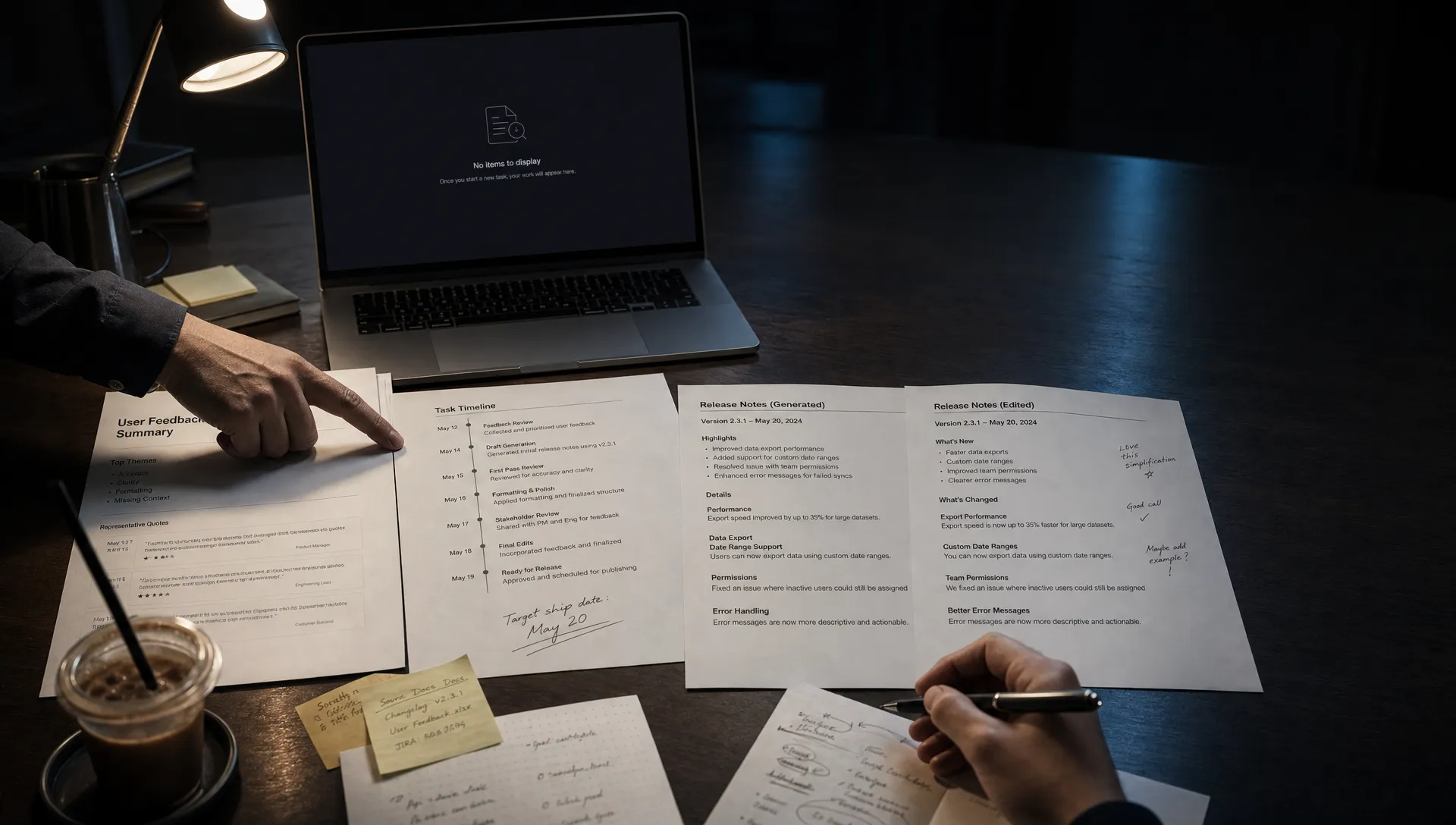
AI for product managers can help expose denominator mistakes when feedback and task histories are matched. Consider an illustrative release-note assistant: nine of 12 interviewees call it useful, but only three of those nine return within seven days. The team concludes that users are being polite.
Now inspect opportunity. Suppose only four of those nine users shipped another release during that window. Three used the assistant again. The original dashboard counted people who had no reason to return alongside people who chose not to use it.
That changes the question. Instead of redesigning onboarding for everyone, investigate the fourth eligible user. Watch them prepare the next release note. Perhaps they tried the assistant but rewrote the draft because checking unsupported claims took longer than writing from their own notes.
You now have two separate findings: a measurement window that does not match task frequency and a possible verification-cost problem. Neither justifies a general claim that users dislike AI. The second finding needs another observed task before it becomes a broader product conclusion.
Choose the next action from the unresolved gap
Return to the exact task rather than asking another general satisfaction question. Ask the user to show what they generated, what they checked and what happened next. “You said this saved time. Which part became faster, and which part still needed your attention?” is more useful than another overall rating.
Then choose one change that addresses the observed cost. If checking unsupported claims is the problem, test a draft that separates supported facts from suggestions. If users cannot move an acceptable output into their workflow, test the handoff. Do not bundle both changes into a general redesign.
The value of AI for product managers is a sharper decision about what to test, not a longer feedback summary. Define the expected behavior before shipping: for example, more completed release notes per eligible task, without more checking time or missed errors.
Keep the user’s own assessment alongside that outcome. Faster completion is not a win if users feel forced to accept output they cannot verify. If the break remains unclear, use the free symptom-based Triage tool to structure the next investigation.
Frequently asked questions
Should feedback or usage get more weight? Give more weight to evidence closest to the decision. Usage can establish that someone returned, but not why. Feedback can explain a choice, but it is stronger when anchored to a specific task and checked against what happened.
Can AI decide which signal to trust? No. AI for product managers can organize records, surface contradictions and suggest follow-up questions. It cannot establish motives from event logs or turn an interview quote into proof of value. Keep the source evidence available for review.
Leave the review with one falsifiable claim
Write this before changing the roadmap: “For this user group, on this task, we think this cost explains the mismatch. We will test it through this change and observe this outcome.”
For a deeper working format, the AI Product Adoption Deck is a 104-card, 124-page PDF with 12 diagnostics, 80 action cards across 10 stacks and 12 workshops with fillable deliverable templates. Use it to turn an unresolved adoption symptom into a concrete product decision, rather than another round of broad feedback collection.