Why Enterprise AI Fails After the Pilot
Enterprise AI often fails after the pilot because pilots hide workflow, trust, handoff, and ownership gaps. Use this diagnostic to fix rollout.

Your enterprise AI pilot looked healthy.
The demo landed. The champion team saw useful outputs. Leadership heard the right words: time saved, workflow automation, better decisions, less manual work. Then rollout started.
Usage flattened. Teams kept asking for training. Managers wanted approvals before outputs could be used. Users copied the AI result into another tool, rewrote half of it, then stopped coming back. Security, legal, data, and procurement raised new questions that the pilot never had to answer.
That is the real enterprise AI adoption problem. The pilot did not prove the product would be adopted. It proved that a supported group of motivated users could get value under controlled conditions.
Gartner predicted that at least 30% of generative AI projects would be abandoned after proof of concept by the end of 2025, citing poor data quality, risk controls, costs, and unclear business value. From a product lens, those are not separate problems. They usually show up as one thing: the product cannot survive normal work.
The pilot asks the wrong question
Most enterprise AI pilots ask, “Can this AI produce something useful?”
Production asks a harder question: “Will this user, in this role, trust this output enough to change how work gets done, repeatedly, with accountability?”
Those are different tests.
A pilot can succeed with high-touch support, preselected use cases, clean data, and a champion who already believes. Production has none of that. It has distracted users, messy edge cases, competing workflows, skeptical managers, compliance reviews, and quarterly business targets.
This is why post-pilot failure often feels confusing. The model may still be good. The output may still be impressive. The adoption loop is what breaks.
What post-pilot failure looks like
Enterprise AI rarely fails in production with a dramatic crash. It fails through small behaviors that look harmless in isolation.
| Symptom after pilot | Likely root cause | Product response |
|---|---|---|
| Users try it once, then do not return | The pilot created curiosity, not a workflow trigger | Define the recurring job and place the AI inside that moment |
| Users copy the output, then heavily rewrite it | Trust is too low or the output is hard to inspect | Add verification, source visibility, assumptions, and edit paths |
| Managers block rollout despite user interest | Ownership and risk are unclear | Define who approves, edits, publishes, and is accountable |
| Outputs are generated but not used downstream | The handoff after generation is missing | Connect the output to the next tool, decision, or workflow state |
| Costs rise faster than value proof | Pilot usage did not model production economics | Track value per completed workflow, not value per generation |
| Teams ask for more training every week | The product depends on expert prompting | Reduce prompt burden with defaults, templates, and guided inputs |
The key is to treat these as diagnostic signals. “Low adoption” is not the diagnosis. It is the symptom.
Five reasons enterprise AI breaks after the pilot
1. The pilot users were not normal users
Pilot users are often handpicked. They are patient, motivated, and close to the sponsor. They forgive rough edges because they understand the strategic intent.
Normal users do not behave that way.
They compare the AI feature against their current workflow, not against the future roadmap. If it takes too much setup, creates review work, or makes them feel exposed, they drop it. They may not complain. They just go back to spreadsheets, docs, Slack, tickets, or whatever already works well enough.
A pilot should include at least some skeptical users. Not blockers for the sake of it, but people who represent the real rollout population. If they cannot find the value without a champion standing nearby, production adoption will be fragile.
2. The context was manually supplied
Many AI pilots work because context is quietly curated.
Someone loads the right documents. Someone explains the use case. Someone cleans the input. Someone knows which edge cases to avoid. The AI looks better because the operating environment has been simplified.
Production is not simplified. Inputs are incomplete. Data is stale. Customer records conflict. Policies change. Users do not know what context matters, and they do not want to become prompt engineers just to complete a routine task.
If your enterprise AI feature needs a perfectly prepared input to work, the product has not solved the adoption problem. It has transferred the work to the user.
3. Verification is treated as a policy, not a product experience
Enterprise users are often told to “review AI output before using it.” That sounds responsible. It is also not enough.
Review is a workflow. It needs affordances.
Can the user see where the answer came from? Can they inspect assumptions? Can they compare the generated output with source data? Can they find what changed? Can they tell whether the AI is confident, incomplete, or guessing?
If not, review becomes slow manual rework. The user may still use the feature once or twice, but trust decays fast. This is especially true in sales, support, finance, legal, HR, healthcare, and any workflow where the user is accountable for the final decision.
If trust is the weak point, the fix is not another model-quality claim. It is better output checkability. The same pattern shows up when AI trust drops because users cannot check the output.
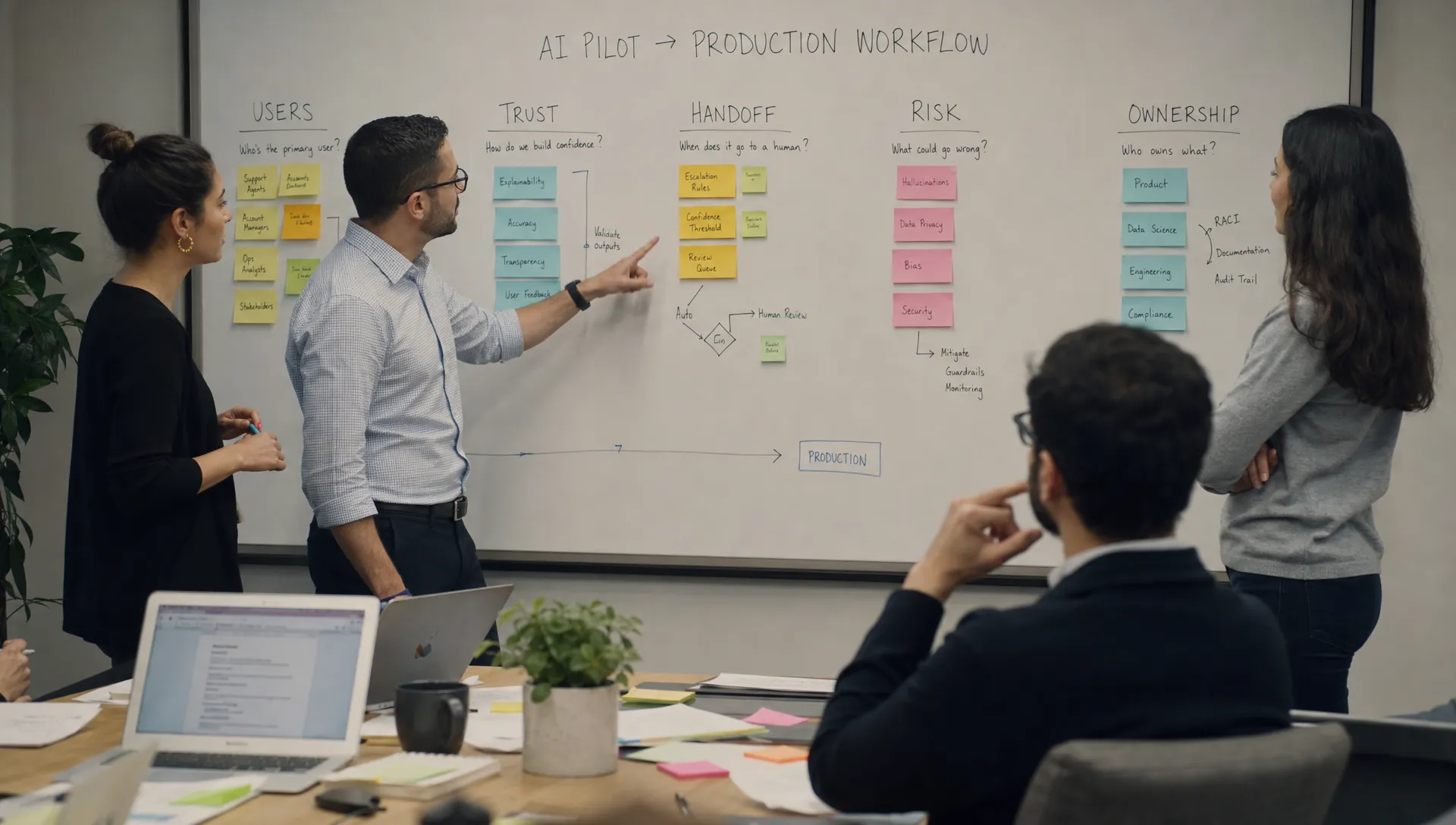
4. The human handoff is fuzzy
Generation is not the end of the workflow.
After the AI produces something, a human usually has to decide what happens next. Approve it. Edit it. Send it. Escalate it. Save it. Merge it into a system of record. Explain it to someone else.
Many pilots stop at the output. Production cannot.
If the output has no clear destination, it becomes another artifact. Users generate a summary, then paste it somewhere else. They generate a draft, then rebuild it in the approved template. They generate an insight, then have no way to attach it to the decision it should inform.
This is where enterprise AI adoption often breaks in plain sight. The AI did a useful thing, but the product did not carry the user into the next step. For a deeper version of this pattern, see why AI at work fails when the human handoff is fuzzy.
5. The value owner disappears after the pilot
During the pilot, everyone knows who cares. There is a sponsor. There are check-ins. There is a success deck.
After rollout, ownership gets blurry.
Product owns the feature. IT owns access. Legal owns policy. Managers own behavior change. Users own final output. Finance owns ROI. Nobody owns the full adoption loop.
That is a problem because enterprise AI value is rarely created at the moment of generation. It is created when the output changes a business process: faster resolution, better customer response, fewer escalations, cleaner forecasts, shorter review cycles, higher win rates, lower operational load.
If no one owns the path from AI output to business result, the feature becomes a novelty with a budget line.
What to measure before scaling beyond the pilot
Do not graduate an AI pilot because people liked the demo. Graduate it when the adoption loop is visible.
| Question to answer | Useful metric | What it tells you |
|---|---|---|
| Do users come back for the same job? | Repeat use by workflow or role | Whether usage is becoming a habit, not exploration |
| Do users trust the output enough to act? | Accept, edit, discard, and regenerate rates | Whether the output is usable in context |
| Can users verify quickly? | Review time and source inspection rate | Whether trust is supported by the interface |
| Does the output reach the next step? | Downstream completion rate | Whether the AI is connected to real work |
| Are managers willing to rely on it? | Approval rate and exception volume | Whether accountability is clear |
| Does value survive real usage? | Cost per completed workflow | Whether unit economics hold outside the pilot |
The important shift is from output metrics to workflow metrics.
“Generated 10,000 summaries” is not a success metric. “Reduced account prep time by 35% while maintaining manager approval rates” is closer. Even then, the number only matters if it holds across normal users, not just the pilot team.
A better post-pilot diagnostic
Before expanding enterprise AI, ask five blunt questions.
- Can the target user explain when they should use this feature without a training session?
- Can they verify the output fast enough that using AI still saves time?
- Does the output have a clear next action, destination, and owner?
- Do managers know what level of review is required before the output is used?
- Is the value measured at the completed workflow, not the generated artifact?
If the answer to any of these is no, scaling will amplify the gap. More seats will not fix it. More enablement may hide it for a quarter, but the usage curve will tell the truth.
This is where a triage step helps. If you need a structured way to map the symptom to the likely adoption break, the free AI product triage tool is built for that first diagnosis. If you want to go deeper, the AI Product Adoption Deck turns those symptoms into action cards, workshops, and product decisions.
Frequently Asked Questions
Why do enterprise AI pilots succeed but fail in production? Pilots usually run in controlled conditions with motivated users, curated data, and hands-on support. Production introduces normal users, messy context, governance, accountability, and workflow friction. The AI may still work, but the adoption system breaks.
Is enterprise AI failure usually a model-quality problem? Sometimes, but not as often as teams assume. Many failures come from weak workflow fit, poor verification, unclear handoff, prompt burden, or missing ownership. Improving the model does not fix those product problems by itself.
What is the best metric for an enterprise AI pilot? The best metric is tied to a completed workflow, not a generated output. Track whether users return for the same job, whether they accept or edit the output, whether it reaches the next step, and whether the business result improves.
How should a team decide whether to scale an AI pilot? Scale only when the recurring use case, trust path, human handoff, and value owner are clear. If the pilot depends on expert users, manual setup, or sponsor pressure, fix those gaps before expanding.
The next decision
Do not ask whether the pilot was impressive.
Ask whether the product can carry a normal user from trigger to trusted output to completed workflow, without a champion in the room.
If it cannot, you do not have a rollout problem yet. You have an adoption design problem. Fix that before you scale it.