Why AI Summaries Fail Users Who Need to Notice Exceptions
AI summaries can be accurate yet hide critical exceptions. Diagnose missed details, redesign the review flow and measure decision quality.

Users open your AI summary, read it and then search the original document anyway. They are not checking whether the prose sounds right. They are looking for the one condition, contradiction or unresolved issue that could change what they do next.
Another group accepts the summary without checking. Their missed exceptions may surface later as bad decisions rather than negative feedback.
Both behaviors can point to the same problem: your feature summarizes the dominant story, but the user's job is to notice what breaks it. Better writing will not fix that mismatch.
A faithful summary can still fail the task
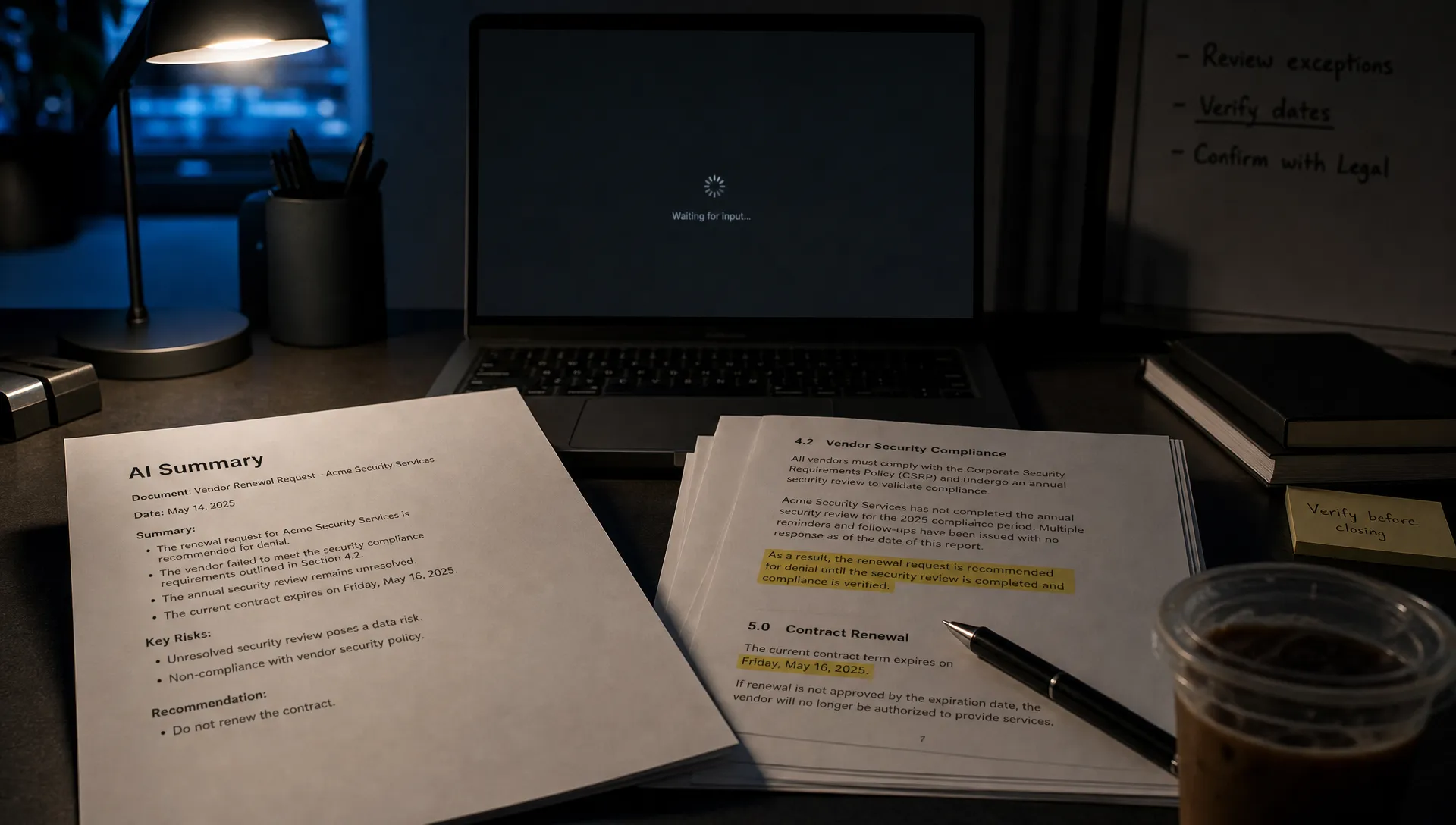
Consider a hypothetical account review covering 12 customers. Eleven have routine follow-ups. One renewal is blocked until a required security review is completed by Friday.
The summary says: “Most renewals are progressing, with routine follow-ups underway.”
That sentence is accurate. It is also insufficient for the person deciding which account needs attention today. The missing fact matters more than the facts that survived compression.
This is different from hallucination. Nothing needs to be invented for the output to fail. A consequential omission is enough.
For this workflow, an exception is a fact that changes the required action, not merely something unusual. A deadline, an unresolved dependency or a condition attached to an otherwise positive statement can all qualify. Its importance comes from the decision, not how often it appears in the source.
Diagnose where the exception disappeared
Before changing the prompt, trace one missed exception through the product. Was the relevant source available? Did its contents reach the summarizer? Did the exception appear in the output? Could the user recognize its significance?
These are different failures with different fixes.
| Observed symptom | Possible cause | What to inspect next |
|---|---|---|
| The exception appears in the source but not in the summary | Compression removed an action-changing detail | Compare the source passage with the generated output |
| A recent exception is absent from both the summary and its inputs | Source coverage or freshness failed | Check included documents, versions and time boundaries |
| The exception appears but reads like a minor detail | Presentation obscures its consequence | Check ordering, labels and whether the required action is explicit |
| Users trust the summary but discover missed issues later | Reliance exceeds the output's demonstrated coverage | Review downstream decisions, not just summary feedback |
Do not treat every return to the source as failure. Opening the exact passage behind a flagged exception may be efficient verification. Rereading the entire document to discover whether anything important was omitted is a different burden.
Ask users what they were trying to rule out when they reopened the source. “I needed to know whether any renewal had a blocker” is a more useful diagnosis than “I don't trust AI.”
Design AI summaries around the decision
Define what must survive compression
“Summarize this account” leaves the selection criteria underspecified. Define the decision first: which renewals need intervention this week?
For that task, the output needs to preserve blockers, deadlines, unresolved approvals and conflicting status reports. A general description of account health is secondary.
Write a short exception rule with someone who does the work: “Flag any unresolved condition that could prevent renewal or requires action before the next review.” Then test it against real examples, including borderline cases.
This rule is a product requirement, not just prompt wording. It should shape input selection, output structure and evaluation. If reviewers cannot agree on what qualifies, the team has not yet defined the task clearly enough.
Separate the overview from the exceptions
A single paragraph forces the user to discover which sentence deserves attention. Give the overview and the exception review different jobs.
The overview provides orientation. The exception section identifies action-changing facts, their consequences and the supporting passages.
For the hypothetical account review, an exception entry might say: “Renewal blocked: required security review remains incomplete. Deadline: Friday. Check review ownership before confirming the renewal.” The source passage should be accessible from that entry.
Do not pad the exception section to make it look useful. Irrelevant warnings create another sorting task. Equally, do not turn “no exception identified” into an unqualified assurance that everything is fine.
Make coverage and uncertainty inspectable
A source link helps users verify a statement that appears in the output. It does not prove that every important statement was included. That distinction matters when source verification is part of the user's trust decision.
Show the relevant coverage boundaries: which records were reviewed, their latest available dates and which expected inputs were unavailable. Keep this close to the exception review, not buried in a generic disclaimer.
Preserve uncertainty in the source, too. “No blocker recorded” is not equivalent to “no blocker exists.” “Approved if legal signs off” is not “approved.” The condition is often the part the user most needs.
When missing information prevents a reliable decision, give the user a clear path to inspect it or defer the decision. Do not quietly convert incomplete evidence into a clean status.
Measure missed exceptions, not just summary satisfaction
A user can rate an output as clear and helpful without knowing what it omitted. Summary satisfaction alone cannot establish that the feature supports exception detection.
Build a test set from completed tasks. Have qualified reviewers identify the action-changing facts and explain which decision each fact affects. Include ordinary cases with no exception, so a system that flags everything does not look successful.
Compare the proposed experience with the existing workflow. Measure:
- Missed-exception rate: The share of reviewer-identified exceptions users fail to notice with each experience.
- False-alarm burden: Flags users must inspect that do not meet the agreed exception rule.
- Decision quality: Whether users choose the appropriate action, including deferring when evidence is insufficient.
- Verification time: Time needed to reach a supported decision, not just time spent reading the summary.
Review consequential misses separately rather than letting many trivial successes hide them. Report results within the tested task and source coverage, not as a universal reliability claim.
For AI user retention, track repeat use alongside these task outcomes. Lower source-opening rates could indicate efficiency or overreliance. Higher rates could indicate useful targeted checking or costly full-document review. The surrounding behavior determines which interpretation fits.
Frequently asked questions
Should we just make the summary longer? Only if length is causing the relevant omission. A longer overview can still bury the exception. Test whether the output preserves action-changing facts and makes them easy to locate.
Can citations solve this problem? Citations support checking included claims. They do not expose every omitted fact. Exception detection also needs defined selection criteria, adequate source coverage and task-based evaluation.
Should the feature ever say “no exceptions found”? It can report that none were identified within the reviewed material, with clear coverage boundaries. That should not imply certainty about missing records or replace required human review in consequential workflows.
Next action: replay one missed exception
Take one recent case where a user reread the source or discovered an issue too late. Trace the exception from source availability through generation to the final decision. Fix the first point where the necessary information disappeared or lost its meaning.
If the break is still unclear, use the free adoption Triage tool to help frame the symptom. For a broader diagnostic workflow, the AI Product Adoption Deck provides 12 diagnostics, 80 action cards and 12 workshops in a 104-card playbook.
Start with one decision the summary must support. Judge the next version by whether users notice what changes that decision, not whether they prefer the prose.