How to Test Whether Your AI Guardrails Build Confidence
Learn how to test whether AI guardrails build confidence, reduce verification load and improve adoption without creating overtrust.

You added warnings, review states, citations, approval gates or refusal copy. Users still hesitate. They rerun the output, paste it into another tool, ask a teammate to check it or abandon the workflow. That is the symptom to test. The question is not whether the guardrail exists. It is whether your AI guardrails build confidence when a user is about to act.
For AI product adoption, confidence is not a feeling users report after the fact. It is the decision to move forward with the output at the right level of care. A useful guardrail helps users understand what is safe, what still needs review and what happens if the AI is wrong.
Do your AI guardrails build confidence or just signal caution?
A guardrail can protect users. It can also make the product feel fragile.
Most AI product teams use several guardrail types at once: scope limits, refusal behavior, warning copy, citations, approval steps, editable drafts, undo paths and human review. That is fine. The mistake is assuming visibility equals trust.
A banner that says “AI-generated content may be inaccurate” may satisfy a risk requirement, but it rarely helps a user decide what to do next. A better guardrail says what was checked, what was not checked and where the user should focus attention.
If you are already working on visible cues, this related breakdown on confidence signals users can actually use goes deeper on the design patterns. This article is about the test: how to know whether those patterns changed behavior.
Start with observable symptoms
Do not begin with a trust survey. Start with what users already do around the AI output.
| Symptom | Likely guardrail problem | What to test |
|---|---|---|
| Users regenerate repeatedly before accepting | The guardrail does not explain what is wrong or what improved | Does actionable feedback reduce retries per accepted output? |
| Users copy output into another tool to check it | Verification is external to the workflow | Does inline evidence reduce outside verification? |
| Users accept output then undo or overwrite it | The guardrail missed a real decision risk | Does earlier review reduce reversals? |
| Users stop at the warning state | The guardrail creates fear without a next step | Does clearer recovery increase completion? |
| Users ignore the guardrail | The warning is too generic or appears too often | Does task-specific copy change edits or approvals? |
A good test starts with one symptom and one moment. “Trust is low” is too vague. “Users abandon the workflow after the warning before publishing a customer-facing answer” is testable.
Measure confidence as a product decision
Ask what a confident user would do differently. Then instrument that behavior.
Useful confidence metrics include acceptance rate, time from output to action, verification steps per accepted output, regeneration rate, edit depth, undo rate, escalation to a teammate and downstream error reports. None of these works alone. The point is to find a pattern.
For example, a guardrail that increases acceptance but also increases later reversals has not built confidence. It has created overtrust. A guardrail that lowers acceptance but catches high-risk mistakes may be working. The metric only makes sense when you know the task risk.
Track at least two paired measures: one adoption measure and one safety or quality measure. For example, measure “accepted without external checking” next to “later corrected by the user.” If both improve, the guardrail probably reduced cognitive load. If one improves and the other gets worse, you have a calibration problem.
Run the test without breaking safety
Do not remove required safety controls in production just to get clean data. Test in prototypes, internal dogfood, low-risk tasks or controlled cohorts where the risk is acceptable.
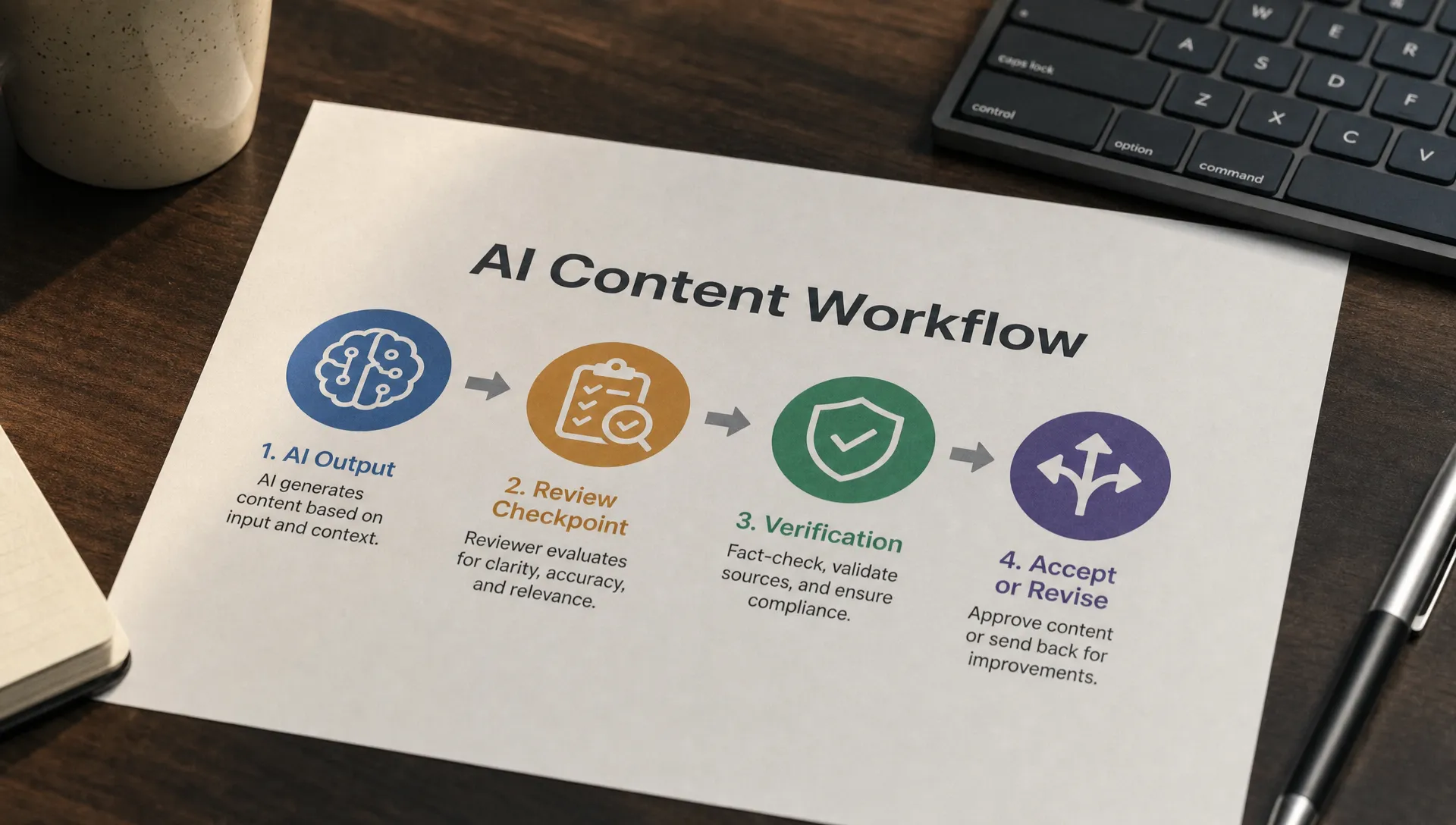
Use a simple four-pass structure:
- Baseline the current behavior: Pick one workflow and capture the abandonment point, edit behavior, verification steps and downstream corrections.
- Write the confidence hypothesis: State the behavior you expect to change. For example, “If we show which source fields were used, users will spend less time checking the generated summary.”
- Compare one guardrail change at a time: Change the placement, wording, evidence or recovery path. Do not redesign the whole flow in the same test.
- Interview after the action: Ask users about the exact output they just accepted, edited or rejected. General trust questions produce soft answers.
Compare guardrail variants, not opinions
The strongest tests compare concrete versions of the same guardrail moment.
| Variant | What it tests |
|---|---|
| Generic warning | Whether the current caution message changes behavior at all |
| Evidence-based guardrail | Whether showing source, scope or checks reduces verification load |
| Actionable guardrail | Whether a clear next step increases safe completion |
| Recovery guardrail | Whether undo, revert or report paths make users more willing to proceed |
Keep the task constant. If users are generating sales emails, do not compare that to legal summaries. The risk, user expectations and verification burden are different.
Also avoid asking, “Which version do you trust more?” Ask what they would do with the output. Would they send it? Edit it? Ask legal? Check the CRM? Confidence shows up in the next action.
Segment guardrails by task risk
The same guardrail can help one workflow and damage another.
A heavy approval step may be right for an AI-generated customer refund decision. It may be wasteful for rewriting an internal meeting note. If you apply the same guardrail everywhere, you teach users to either ignore it or fear the whole feature.
Segment tasks by reversibility, visibility, financial risk and user expertise. NIST’s AI Risk Management Framework is useful here because it treats risk as context dependent. For product teams, the practical version is simple: match the guardrail to the cost of being wrong.
If this is the break in your product, use a task-risk lens before changing copy. This guide on how to calibrate AI trust by task risk covers that decision in more detail.
Read the result bluntly
After the test, do not round every outcome into “users need more education.” Most guardrail failures are product failures, not training gaps.
If users still verify everything outside the product, the guardrail did not make evidence inspectable. If users stop at the warning, the guardrail raised risk without giving a safe next step. If users accept too quickly and mistakes rise, the guardrail made the output look safer than it was. If users ignore the guardrail, it is probably too broad, too frequent or disconnected from the task.
A confidence-building guardrail should do at least one of three things: reduce unnecessary checking, focus necessary checking or improve recovery when the AI is wrong. If it does none of those, it may still be a compliance requirement. Just do not confuse it with adoption work.
Frequently Asked Questions
Should we ask users whether they trust the AI? You can, but treat it as supporting evidence. Behavior is stronger. Look at what users accept, edit, verify, undo and abandon.
Can a guardrail reduce adoption and still be the right decision? Yes. For high-risk tasks, a guardrail may correctly slow users down. The test is whether it slows the right actions and prevents the right failures.
How long should an AI guardrail test run? Long enough to capture real task behavior, not just first impressions. For low-volume workflows, pair product analytics with moderated sessions using real user tasks.
What if legal or compliance requires generic warning copy? Keep the required warning, but add useful decision support near the action. Required caution does not have to be the only guardrail.
Next action
Pick one shipped guardrail this week. Write down the unsafe action it prevents, the confident action it should enable and the behavior that should change if it works.
If the symptom is broader than one guardrail, run the free AI adoption triage workflow. If you want a structured way to turn the diagnosis into product changes, the AI Product Adoption Deck includes diagnostics, action cards and workshops for trust, verification, onboarding and retention problems.