How to Recover User Confidence After an AI Mistake
Recover user confidence after an AI mistake with a diagnostic plan for ownership, inspection, repair paths and adoption metrics.
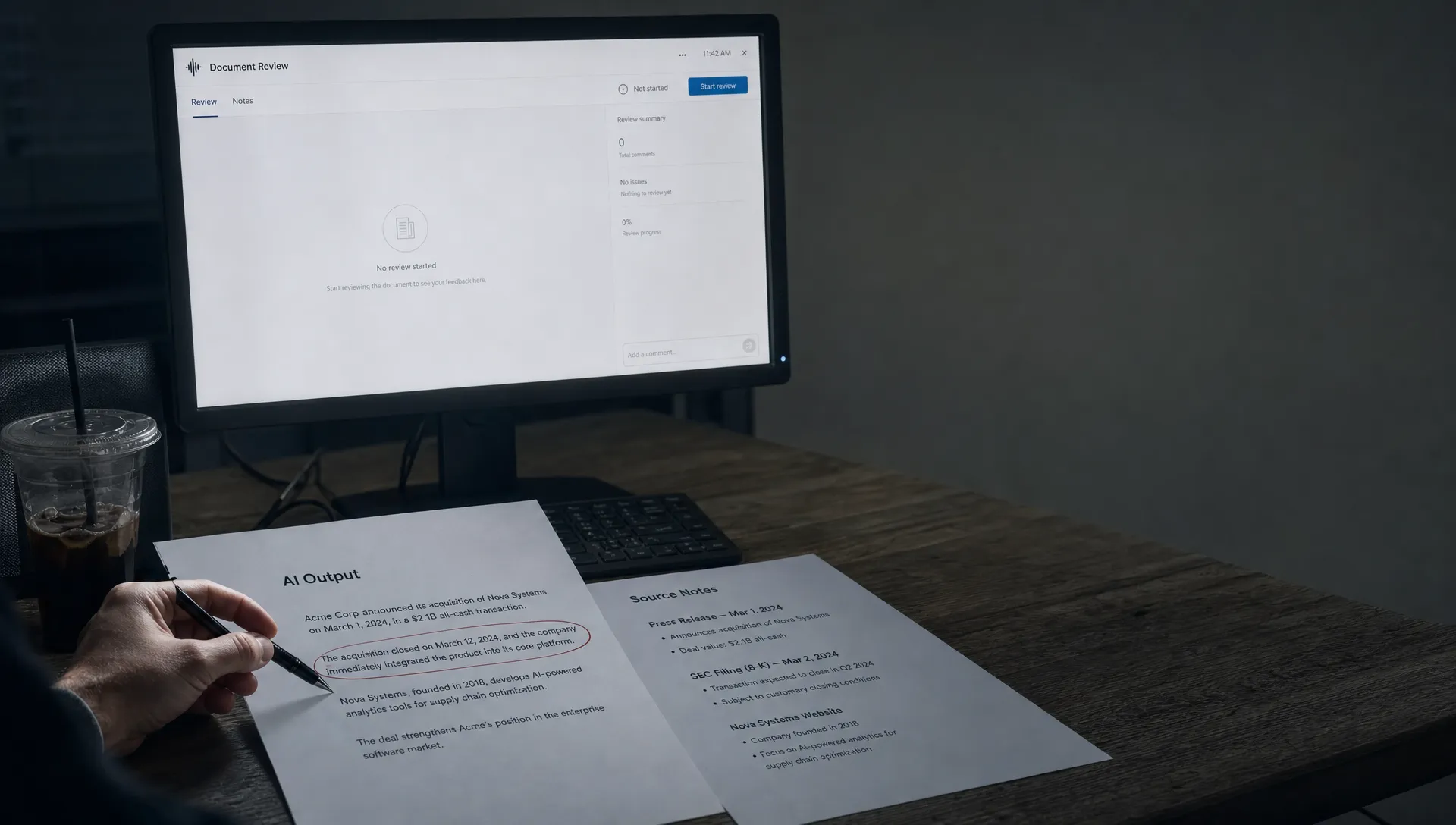
Your AI feature made a visible mistake. The user caught it, not the product. Since then, acceptance is down, regeneration is up and the feature is suddenly treated like a toy instead of part of the workflow. This is one of the fastest ways AI product adoption turns from promising to fragile.
The fix is not a better apology banner. It is not a generic confidence score. Confidence comes back when the product proves three things: the mistake is understood, the user can inspect what happened and the next attempt is safer than the last one.
First diagnose what confidence actually broke
After an AI mistake, teams often jump straight to model quality. Sometimes that is the problem. More often, the adoption break is in the recovery path.
Users do not need the system to be perfect. They need to know what happens when it is wrong. If the only available move is “try again,” users learn that recovery is their job. That changes the role of the feature. It moves from assistant to liability.
Use the post-mistake behavior to diagnose the real break.
| What users do after the mistake | Likely confidence break | Product response |
|---|---|---|
| Stop accepting AI outputs | They cannot tell which parts are safe | Make claims, sources and assumptions inspectable |
| Copy the output into another tool to check it | Verification moved outside the product | Add in-product verification steps |
| Regenerate the same request many times | They cannot repair the output directly | Add targeted edit and correction controls |
| Avoid high-value workflows | The blast radius feels too large | Add boundaries, previews and approval gates |
| Blame themselves for prompting badly | The product did not own the failure | Clarify what the AI misunderstood or missed |
This table matters because each symptom needs a different product decision. A trust gap is not solved by onboarding. A repair gap is not solved by better copy. A boundary gap is not solved by a more fluent answer.
How to recover user confidence after an AI mistake
Recovery should be designed as a product flow, not a support event. The user should move from “this failed” to “I know what failed, I can fix it and I can safely continue.”
Own the mistake inside the workflow
A vague message like “AI can make mistakes” protects the company but gives the user no help. It also shifts responsibility onto the user at the exact moment the product needs to earn confidence back.
A better recovery message is specific about the failure mode. It might say the AI used an outdated source, missed a constraint, summarized the wrong section or inferred a field that was not present. The wording should be calm and plain. No drama. No over-apology. Just enough ownership for the user to understand what happened.
The best ownership messages also separate model behavior from user behavior. If the user gave a clear instruction and the AI ignored it, say that. Do not imply they should have prompted better.
Make the bad output inspectable
Users regain confidence when they can see why the answer failed. If your product hides the reasoning trail, source material or transformation steps, the user has to reconstruct the error from scratch.
For writing tools, show the source text and the changed sections. For analysis tools, show the fields used, skipped and inferred. For workflow automation, show the action plan before execution. For coding tools, show the affected files and test impact.
If this is already a pattern in your product, the issue may be less about accuracy and more about inspection friction. The deeper breakdown is covered in why AI trust drops when users cannot check the output, especially for teams seeing repeated outside verification.
Give users a repair path, not just a retry button
“Regenerate” is a weak recovery mechanism. It asks the user to gamble again. It also discards useful parts of the output, which makes the mistake more expensive than it needs to be.
Better repair controls are narrow and local. Let users fix the wrong assumption, exclude a source, lock approved sections, change tone without changing facts or re-run only the failed part. This turns recovery from a full reset into a controlled edit.
A good repair path also teaches the system what mattered. If a user rejects a summary because it omitted risk factors, the next run should not simply produce different prose. It should treat “include risk factors” as a constraint in that workflow.
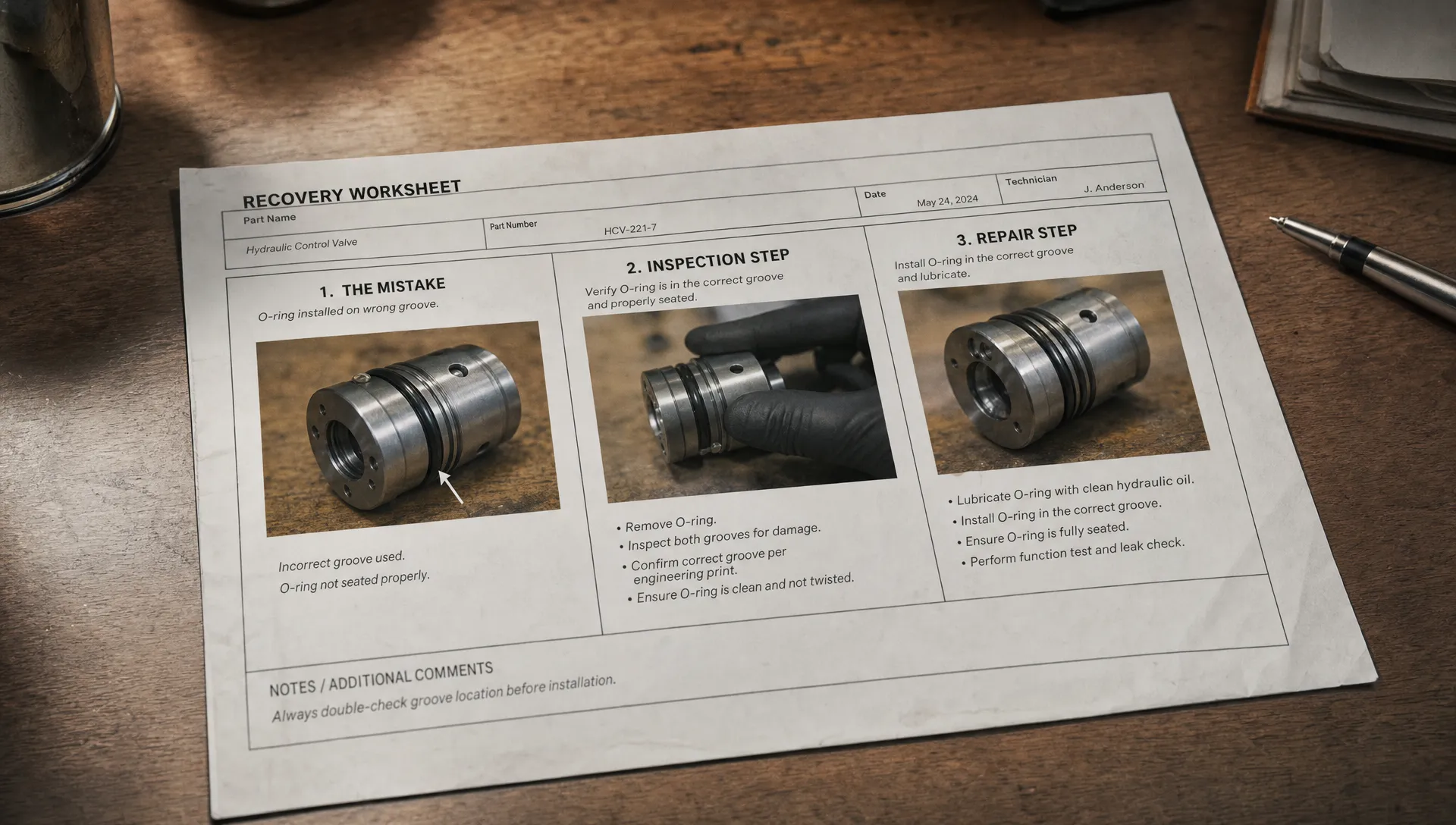
Show what changed before asking for trust again
After a visible mistake, the next output carries extra burden. The user is not evaluating it from zero. They are looking for proof that the product learned from the failure.
Show the change explicitly. Use labels like “Rechecked against source,” “Constraint applied,” “Only changed the flagged section” or “Human approval required before sending.” The point is not to claim certainty. The point is to make the recovery move visible.
This is where many products lose users a second time. The retry may be better, but if the product does not show why it is safer, the user still has to trust the black box.
What not to do after a bad AI answer
Some common recovery moves look useful in roadmap reviews but fail in real usage.
Do not add a generic confidence score after the fact. A label like “82 percent confident” rarely helps the user decide what to check, what to accept or what to ignore. If you use confidence signals, tie them to evidence the user can inspect.
Do not bury the failure in a disclaimer. Users already know AI can be wrong. They need help understanding whether this output is wrong and what to do next.
Do not make the user start over. If the user invested time shaping the input, selecting context or editing the answer, a full reset makes the product feel careless.
Do not treat support tickets as the recovery mechanism. Support can explain the failure later. It cannot save the workflow in the moment.
Measure whether confidence is actually returning
Post-mistake recovery should show up in behavior. Surveys can help, but the strongest signals are inside the workflow.
| Recovery metric | What it tells you |
|---|---|
| Acceptance rate after correction | Whether repaired outputs are usable |
| Time to verification | Whether users can check the output quickly |
| Repeat use in the same workflow | Whether the mistake damaged habit |
| Regeneration rate after repair | Whether the repair controls are specific enough |
| Manual override rate | Whether users still feel they need to take control |
| Return usage after a failed session | Whether confidence survived the incident |
Segment these metrics by workflow risk. A mistake in brainstorming is not the same as a mistake in customer email, legal review, data analysis or production code. The recovery standard should match the consequence of being wrong.
For AI user retention, the key question is not “did they come back to the product?” It is “did they come back to the same workflow with the same level of responsibility?” If users only return for lower-stakes use cases, confidence has not fully recovered.
If the mistake happened outside your product
Not every AI mistake happens inside your UI. For some teams, the damage starts when an external AI system describes the product incorrectly, invents capabilities or cites the wrong source. This matters for product confidence because users may arrive with a false expectation before onboarding even begins.
If your product depends on brand discovery, category education or AI-assisted research, run an AI visibility audit to see how tools like ChatGPT, Claude, Perplexity and Google AI describe your company. When the market hears the wrong story before trying the product, in-product recovery has to work harder.
The same principle applies: identify the wrong output, inspect the source of the mistake and correct the surface where users encounter it.
A practical recovery decision frame
When you are deciding what to ship after an AI mistake, use five questions.
- What exactly did the AI get wrong?
- Could the user inspect that failure before acting on it?
- Could the user repair the output without starting over?
- Did the product reduce the blast radius of the mistake?
- Will the next run visibly apply what was corrected?
If the answer to any of these is no, you do not have a confidence problem in the abstract. You have a missing product surface.
For teams that need to diagnose which surface is missing, the free AI adoption triage tool can help map symptoms like output abandonment, repeated regeneration or low repeat use to the likely adoption break. If you want to go deeper, the AI Product Adoption Deck turns those symptoms into action cards, workshops and concrete product decisions.
Frequently Asked Questions
How do you rebuild trust after an AI mistake? Start by owning the specific failure, then make the output inspectable and give the user a narrow repair path. Trust returns when users can see what went wrong and safely continue the workflow.
Should we show users a confidence score after an AI error? Usually not by itself. A confidence score only helps if it points to evidence, such as sources, changed fields, missing inputs or steps the user can verify.
Is one bad AI answer enough to hurt retention? Yes, if the mistake affects a high-stakes workflow or leaves the user without a clear recovery path. The damage is worse when users have to discover, explain and fix the error alone.
What is the best product response to an AI hallucination? Do not just apologize or regenerate. Show the unsupported claim, identify the missing or wrong source and let the user remove, replace or verify that part of the output.
How should product teams prioritize recovery work? Prioritize the workflows where mistakes have the highest consequence and where users currently leave the product to verify results. Those are the places confidence is most likely to break again.