AI Shipping Fails When Teams Skip the Post-Launch Review
AI shipping needs a post-launch review. Find adoption breaks, expose hidden costs and decide what to fix, narrow or stop before shipping again.

Your AI feature gets tried, generates plenty of output and then disappears from users’ routines. The launch dashboard still looks respectable. Nobody can explain whether users finished the job, abandoned the output or quietly returned to the old workflow. This is where AI shipping fails: the team treats release as the end of the learning cycle.
A post-launch review should expose that gap. This is not the user’s review of an AI-generated answer. It is the product team’s review of whether the feature delivered useful work, at an acceptable cost, often enough to earn another use.
Start with a task, not the release dashboard
Choose one job the feature was supposed to improve. “People use our assistant” is not a job. “Support agents resolve eligible billing questions without rewriting the suggested reply” is specific enough to investigate.
Then define the observable outcome. Generation is an intermediate event. So are opening the panel, copying text and accepting a suggestion. None proves that the output survived review or helped complete the task.
Write down what would count as evidence of completion. Depending on the workflow, that might be a reply sent after editing, a proposed change merged after review or a document approved by its intended recipient.
The review question is whether the user’s job improved, not whether the AI ran. Keep the original launch hypothesis visible so the team cannot quietly replace an outcome target with an easier activity metric.
AI shipping needs a decision, not a status update
Bring evidence that distinguishes different breaks in adoption. A falling usage curve alone cannot tell you what to change.
| Observed symptom | Possible break | Evidence to inspect | Candidate response |
|---|---|---|---|
| Users open the feature but never generate | Unclear starting point or missing context | First-session observation and input abandonment | Offer a task-specific starting path |
| Users generate but discard the result | Output misses requirements or is hard to verify | Abandoned task sessions and user explanations | Improve context capture or verification |
| Users accept, then undo or heavily rewrite | Acceptance hides downstream cleanup | Revision history and completed work | Fix correction controls or narrow scope |
| Users succeed once but do not return | Weak recurring trigger or poor workflow placement | Next eligible task and chosen alternative | Integrate at the actual point of need |
| Users accept risky output without checking | Overreliance rather than healthy adoption | Review behavior and sampled outcomes | Add risk-appropriate approval steps |
These are hypotheses, not diagnoses. Use observed behavior and completed work to test them. The free symptom-based Triage tool can help structure that investigation when the team is debating which break to examine first.
Separate first-use friction from repeat-use failure
Do not combine everyone into one adoption average. Separate users by task, first-use period and the feature version they experienced. Someone who tried an early release should not disappear inside the results for a redesigned flow.
For AI shipping, repeat use only becomes meaningful when another relevant task occurs. A monthly reporting feature should not be judged by daily return rates. Ask whether the user chose it at the next reporting cycle.
Compare three groups: people who never reached a useful result, people who completed the task once and people who returned at another opportunity. Sample sessions from each group, including users who stopped responding to surveys.
Ask what happened to the output and what they used instead. “I checked every sentence in another tool” reveals something different from “I didn’t have another task.” The first suggests a trust or verification problem. The second may be normal task frequency.
Record uncertainty. If you cannot observe the next eligible task, say so rather than labeling every absence as churn.
Count the work users had to absorb
A fast generation step can create a slow workflow. Include context preparation, checking, correction and handoff in the review. Also inspect support escalations and rework caused by accepted output that turned out to be wrong.
Treat time saved as a hypothesis until you have a reasonable comparison with the previous workflow. Do not subtract generation time from manual task time and call the difference value.
The economics of AI shipping belong in this review too. Track service costs against completed useful tasks, not just requests. Keep user effort visible alongside direct spending; it does not need an invented hourly price to matter.
Invite whoever owns the financial assumptions. For a founder-led business, that might be an internal finance lead or a part-time CFO partner such as CFOLab. Their contribution is to challenge cost and savings assumptions, not assess model quality.
If the feature shifts work from one employee to another, record the transfer. A faster first draft is not a workflow saving when the approver inherits more checking.
Write one testable decision before the meeting ends
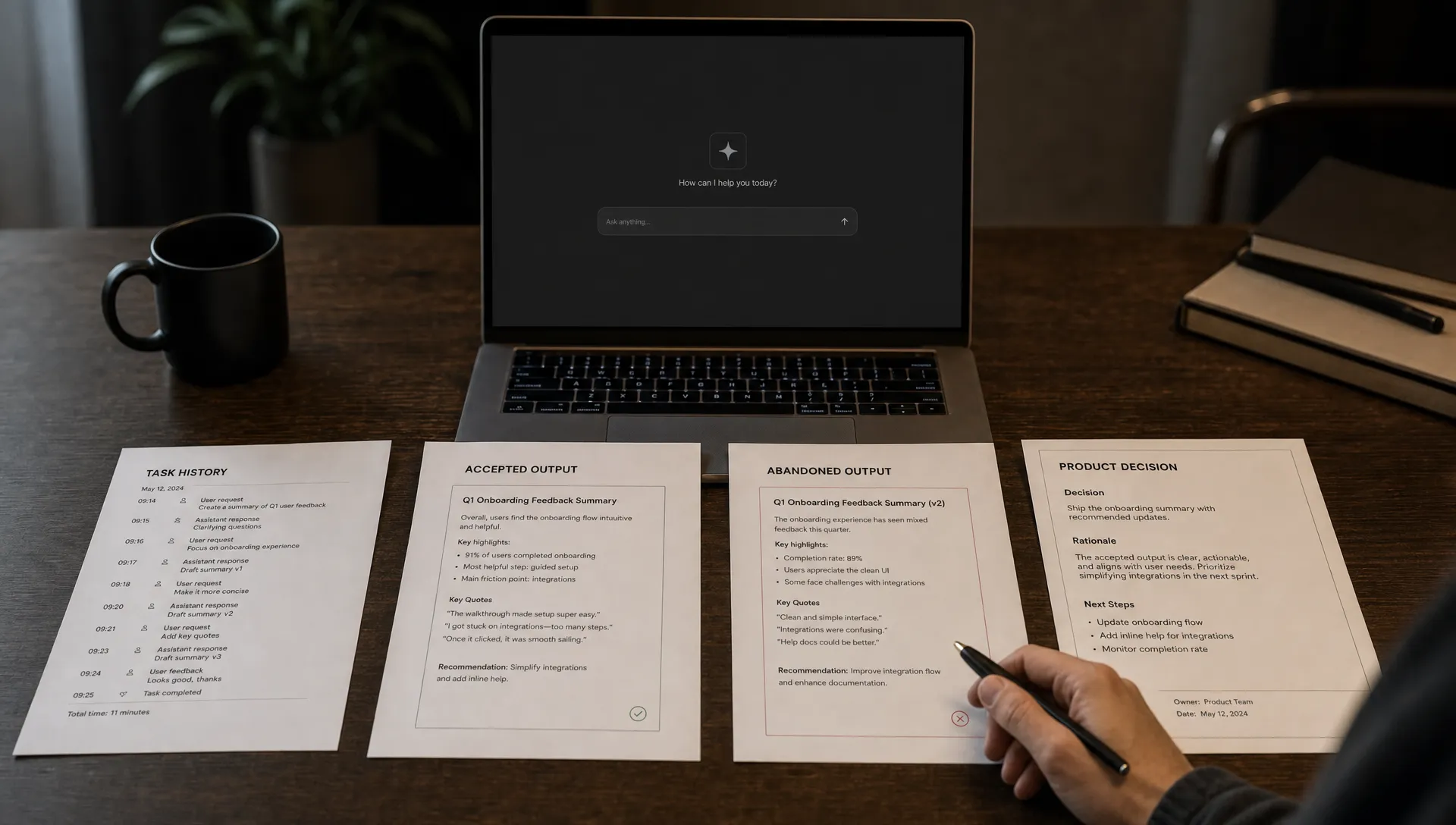
The review should end with a bounded change, an owner and evidence that would justify keeping it. “Improve quality” is not a decision. Neither is “add onboarding.”
For example, suppose users abandon suggested replies because they cannot verify account-specific claims. A reasonable experiment might show the supporting account facts beside the draft. Measure whether more eligible replies survive review without increasing incorrect claims being sent.
Keep AI shipping accountable to both usefulness and risk. A higher acceptance rate is not a win if users become less likely to catch consequential mistakes.
Use a short decision record:
Observed break: Users discard drafts containing unverifiable account claims. Hypothesis: Verification effort outweighs drafting value. Change: Show the relevant source facts beside those claims. Owner: Named product lead. Success evidence: More completed replies with less checking effort. Guardrail: No increase in sampled factual errors reaching customers.
Before authorizing a larger release, use these questions to ask before shipping again to challenge the proposed fix. The point is to test the suspected cause, not fund another feature bundle.
Schedule the next review around the job
Choose the next review date before closing the current one. Base it on how often the task occurs and how quickly you can collect meaningful evidence. A daily support workflow and a quarterly planning workflow need different observation windows.
If usage is sparse, combine task observation with explicit uncertainty. Do not turn a handful of sessions into a confident retention claim.
Keep the experiment interpretable. Record changes to defaults, onboarding and underlying output behavior during the observation window. Otherwise, the next review may find movement without knowing what caused it.
The available decisions should include continuing, repairing, narrowing access or pausing the feature. Shipping another iteration is not the default answer.
Frequently asked questions
How is this different from a launch retrospective? A retrospective examines how the team delivered the release. A post-launch review examines what users achieved afterward. AI shipping needs both, but delivery lessons cannot substitute for evidence of useful work.
Should low adoption trigger a model change? Only when evidence points to output capability as the constraint. Missing context, difficult verification or a broken correction loop can produce low adoption even when the underlying output is adequate.
Run one review before the next release
Pick one task, one recent user cohort and one suspected break. Assemble completed work, abandoned attempts and downstream corrections. Leave the meeting with one testable decision and a review date.
If you want a more structured diagnostic process, the AI Product Adoption Deck is a 104-card, 124-page playbook with 12 diagnostics, 80 action cards across 10 stacks and 12 workshops with fillable deliverable templates. Use it to turn an adoption symptom into a concrete product decision before adding more scope.