AI Oversight Should Start Before Users See the Output
AI oversight starts before users see output. Diagnose missing checks, define release rules and measure safeguards without blocking useful work.
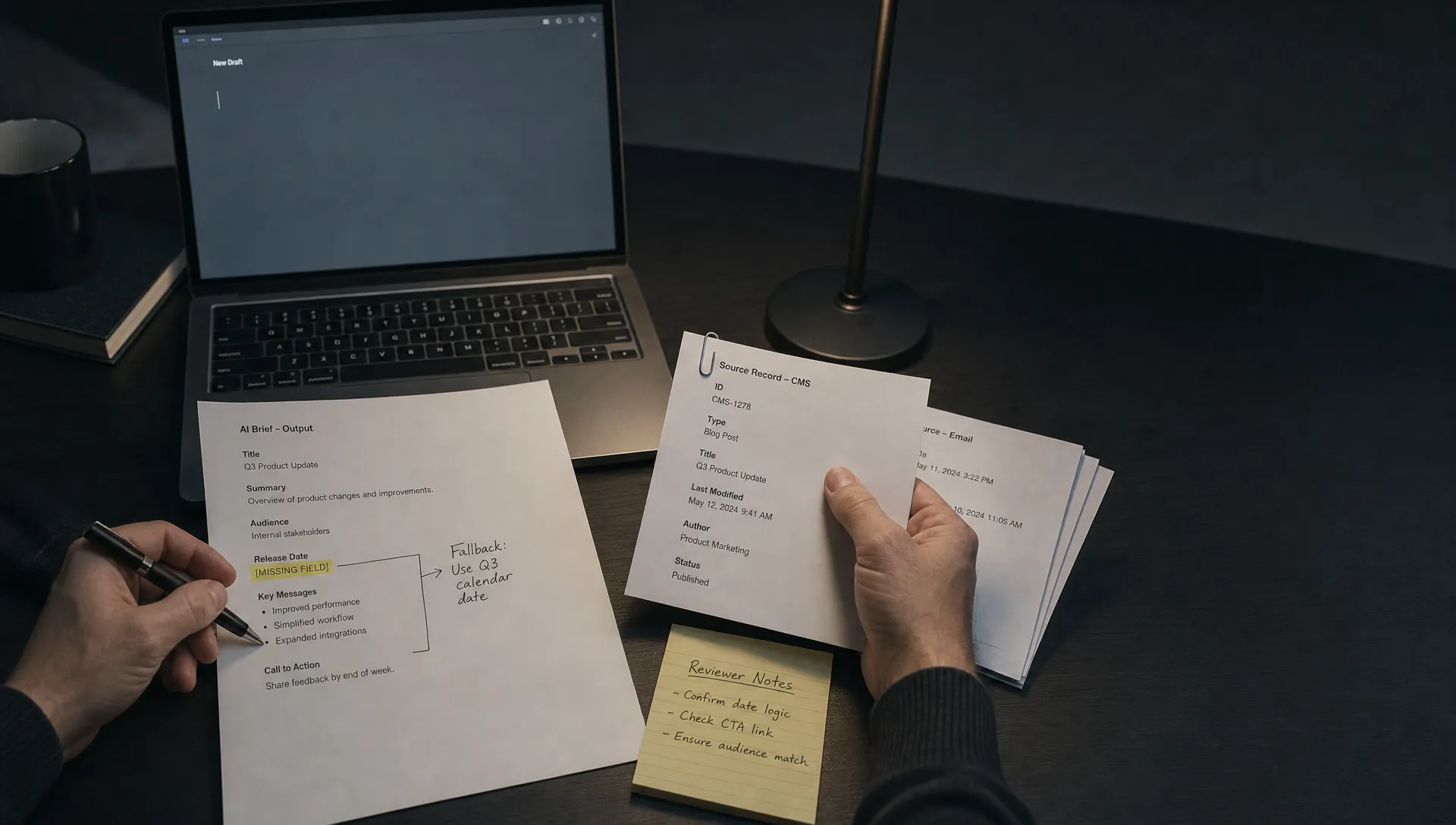
Users generate an account brief, inspect every claim, then rebuild it from the underlying records. Your activation numbers look fine. The feature still does not become part of their workflow. AI oversight may be arriving too late: the first meaningful check happens after the product has already presented a finished-looking answer.
A review button does not fix that. Neither does a disclaimer telling users that AI can make mistakes. If the product accepts incomplete context, invents a missing date or mixes records the user should not access, the user inherits a problem the system should have caught earlier.
The diagnostic question is not simply whether a human can review the result. It is whether the product has defined what must be true before that result reaches anyone. Start there before adding another approval screen.
AI oversight needs a checkpoint before display
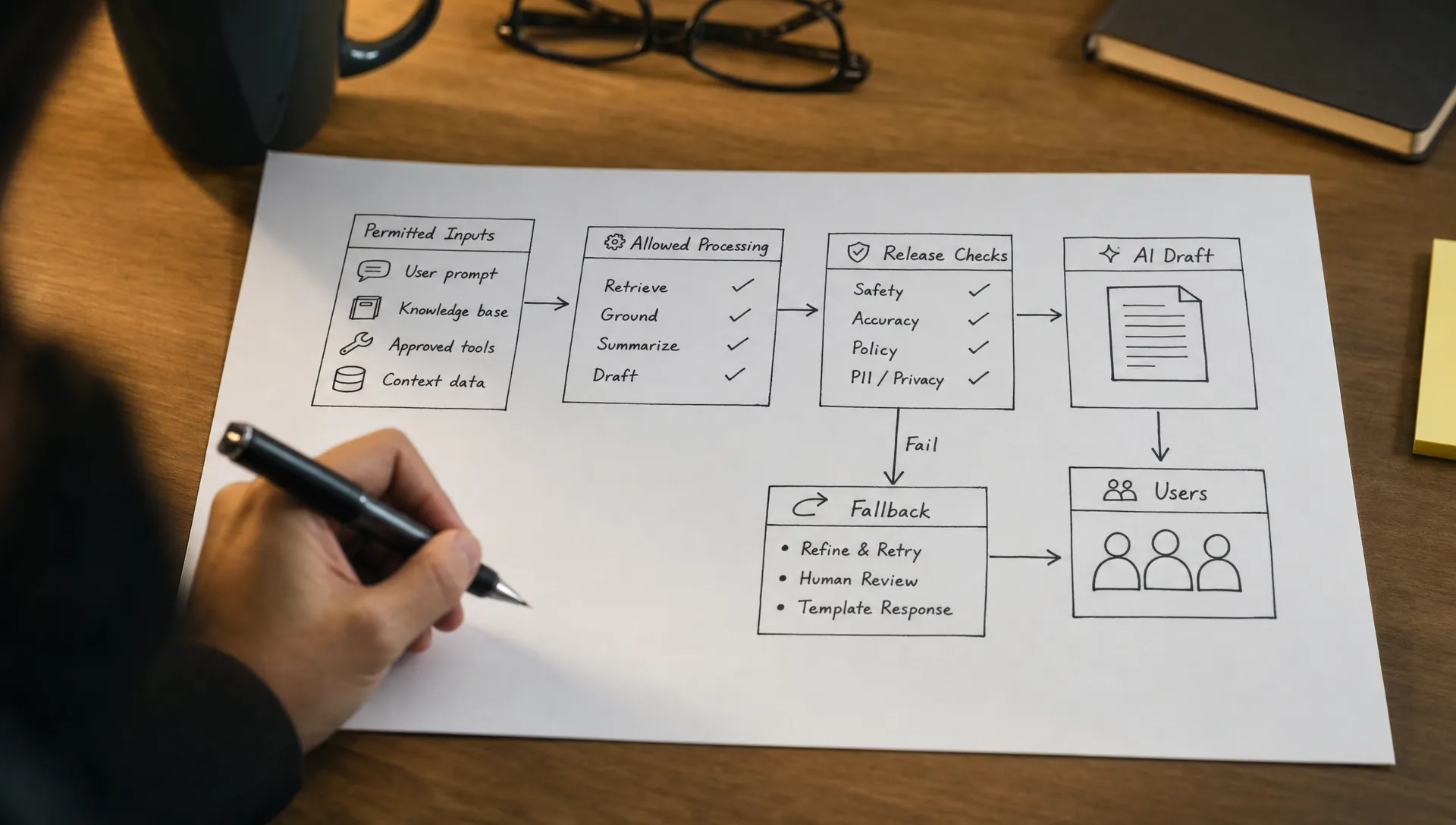
Oversight is broader than asking someone to approve a draft. It includes deciding which requests the feature can handle, what information it may use, when to stop and who handles exceptions.
The NIST AI Risk Management Framework treats risk management as work across the AI lifecycle, not just a final inspection. For a product team, the practical implication is straightforward: some controls belong before generation, others before display and others before an action takes effect.
Use observed behavior to locate the missing checkpoint:
| What you observe | Possible upstream failure | What to investigate |
|---|---|---|
| Users rebuild briefs from original records | Required context is missing or stale | Input completeness and freshness rules |
| Users repeatedly remove unsupported claims | The feature treats inference as fact | Which claims require authoritative evidence |
| Users avoid certain accounts or documents | Access boundaries are unclear | Permission enforcement before retrieval |
| Reviewers approve everything immediately | Review is overloaded or poorly targeted | Which cases actually need human judgment |
These are hypotheses, not conclusions. Watch sessions and inspect examples before changing the workflow.
AI oversight is misplaced when users repeatedly discover failures that a defined product rule could have intercepted. That is different from a genuine need to interpret an ambiguous recommendation. Users still need a practical way to check the output, but verification should not compensate for missing basic controls.
Write a release contract for one output
Choose one output type, such as an account brief. Write a short release contract: the conditions under which the product may show it, what it must omit and what happens when those conditions are not met.
This is a product specification, not a prompt asking the model to “be careful.”
Check context before generation
Define which records are allowed, which fields are required and which source wins when records conflict. Enforce access permissions through the application’s authorization rules, not through instructions in the prompt.
For a hypothetical account brief, the renewal date might come only from the designated contract record. If that record is unavailable, the product should not reconstruct the date from an old email.
AI oversight starts with preventing an unsupported request from becoming an apparently complete answer. A missing optional field may allow a partial brief. An unresolved access check should stop use of that source.
Check release conditions before display
Separate checks the application can enforce directly from judgments that remain uncertain.
A required source identifier, a valid account match or a date copied from a designated field can have explicit validation rules. Whether a recommendation fairly represents a complicated customer relationship may require human judgment.
Do not ask the same generator whether its own answer is safe and treat “yes” as proof. Automated evaluators can flag cases for inspection, but they can also miss errors.
Write the consequence of each failed check. “Flag the output” is incomplete. Specify whether to remove a claim, return a partial draft, request missing context or withhold the result.
Design the exception path, not just the happy path
A safeguard that stops output without explaining the next step can create a different adoption failure. Users experience an unreliable feature, then work around it.
For the account brief, a useful fallback might say: “The renewal date could not be confirmed. This draft excludes renewal timing.” That is appropriate only if the remaining content passes its own checks. Do not label an unchecked remainder as safe.
Some cases should go to a reviewer. Give that reviewer the disputed claim, relevant evidence, the reason for escalation and a defined decision. “Review this brief” is too broad.
Assign an owner and an expected response window. Decide what users see if nobody responds. A pending review must not silently become an approval when a timer expires.
Keep the workflow proportional. A private, editable summary does not need the same handling as a recommendation that changes a customer’s access or commits money.
Measure intercepted failures and the friction you add
A higher block rate does not prove the feature is safer. A lower correction rate does not prove quality improved if frustrated users stopped trying.
AI oversight needs measures of both error interception and useful continuation. Track the share of requests stopped, the reason for each stop and whether the user completes the intended task afterward. Sample blocked cases to estimate how often acceptable work was stopped unnecessarily.
For released outputs, sample cases for failures that escaped the controls. Track user corrections and downstream rework, but do not assume that an absence of edits means the answer was correct. Users may accept mistakes without noticing them.
For human review, measure queue age and decision time alongside the issues reviewers catch. If requests accumulate faster than reviewers resolve them, the workflow needs a different routing rule or more capacity.
Keep the unit consistent: a user task is not the same as a generation attempt. Automatic retries can inflate request counts and make completion rates misleading.
Test the earliest preventable failure
Before building a general oversight dashboard, take a small set of recent abandoned or heavily corrected outputs. Include successful sessions for comparison.
For each case, record the first preventable failure, the earliest point where it could have been detected and the user’s eventual outcome. Do not start with the final typo if the real problem was an unauthorized source or a missing contract record.
Turn the most repeated failure into one release rule. Test that rule against previous failures and previously acceptable outputs. Then monitor a limited rollout for escaped errors, unnecessary stops and task completion.
The decision is specific: does this checkpoint remove work users should not have been doing, without blocking work they could safely complete?
Frequently asked questions
Does human oversight mean reviewing every AI output? No. Human judgment is most useful where consequences or ambiguity justify it. Routine permission and required-field checks should be enforced by the product rather than delegated to users.
Should we hide every uncertain result? No. Some uncertainty can be communicated in a useful partial draft. Withhold output when it fails a required release condition, rather than treating all uncertainty as equivalent.
Is this the same as AI governance? No. Governance sets accountability, policies and organizational expectations. Product oversight implements specific controls within a workflow. Those controls alone do not establish regulatory compliance.
Start with one release rule
Bring one failed output to your next product review. Name the condition that should have stopped or changed it, the owner of that rule and the fallback users need.
If you are unsure which adoption failure you are seeing, use the free Triage tool. For a deeper working process, the AI Product Adoption Deck provides 12 diagnostics, 80 action cards and 12 workshops. Use that structure to turn an AI oversight concern into a testable product decision, not another blanket approval step.